Gain Insider Knowledge of the Private Equity and Small Business Worlds

As a business owner, it can be hard to decide between maintaining business ownership or selling. Many business owners are passionate about their companies and want to remain tied to future growth. At the same time, running a company can be stressful, or the company can get large enough that additional expertise is necessary to grow it to the next level. Whatever the exact situation, the options are not as black and white as to sell or not to sell. There is a third option, where the owner can have it both ways: private equity recapitalization.

In a recapitalization, the business owner retains many benefits of ownership while gaining the ability to diversify assets, lessen ownership stress, and even profit from a second sale.

What is Recapitalization?

A recapitalization is when a business changes its capital structure, specifically in the ratios of debt and equity financing. This can look like paying off debts to increase the amount of equity and decrease interest payments, or the company buying back shares, exchanging equity for debt, in order to return capital to the owners. Or it could be the company issuing new shares and raising additional equity capital.

Private Equity Recapitalization

In the context of private equity, a recapitalization often means the business owner sells part of the business while retaining ownership in the remaining portion. For example, a business owner could sell 80% of the business to a private equity firm. The liquidity from the sale allows the past owner to diversify his or her wealth, pay off debts, or meet personal goals while remaining invested in the company’s growth. Then, when the private equity firm sells the company down the road— typically in about five to seven years— the past owner receives the value of the remaining 20%. Effectively, the original owner capitalizes on the business sale twice. The proverbial second bite of the apple.

Why Recapitalize?

Why would a business owner choose to recapitalize? While every situation is unique, below we elaborate on some common factors.

Ownership Privileges

As stated earlier, some company owners want to remain involved in their company while minimizing burnout and stress. Maybe the owner wants to sell eventually, but is not yet ready to let go emotionally. This allows the owner to slowly phase out of decision-making, often serving as an active advisor to the new owners in the interim. This aspect can help the company, too, as the past owner shares expertise with the new owners— often the private equity firm— setting the company up for continued success.

Private Equity Resources

Oftentimes, the original owner forges a partnership with a private equity firm because the company has reached a growth ceiling in terms of financial resources, expertise, or both. Maybe the next step is to expand into a new market, purchase expensive equipment upgrades, or even acquire another company. Often these bigger changes require significant capital or management expertise, and the past owner may not have these resources. If the owner wants to see continued growth (and benefit from it down the road), then a partnership with private equity may provide the necessary resources.

Delayed Liquidity from Second Sale

This is where recapitalization gets the description “sell your company twice.” The second sale, though a smaller percentage of ownership, can result in a large payout down the road. This is because the private equity firm is often able to grow the company significantly during its ownership period, driving company value up. This amplified growth in a short time window is due to the private equity firm’s management expertise, financial resources, and also collaboration with the past owner.

While 1719 Partners’ ownership period is not limited to five or seven years, we prioritize collaborating with the past owner in recapitalization transactions to set the company up for continued growth. We believe our resources and the past owner’s wisdom creates a powerful combination for success.

Diversification

Even if the company is doing well, it is still risky for the owner to have all his or her financial success tied to the company. There is always the chance something could happen, and the resulting loss could be great. Recapitalization allows the owner to diversify wealth in other investments, decreasing risk, while also remaining invested in the company. Here the past owner gets the “best of both worlds” from an investment perspective.

Is Private Equity Recapitalization Right for You?

There are many reasons to recapitalize, and a variety of benefits for doing so. If your company needs a new area of expertise or increased financial resources, then partnering with a private equity firm to recapitalize might make sense. Or if you would like to retain decision-making power in your business but want the reduced stress that comes with a smaller role, or you would like to take some chips off the table, recapitalization might be right for you.

1719 Partners is experienced in navigating recapitalization transactions, making the best decisions for the company’s future as well as for the owner. If you are curious about the unique benefits of recapitalizing with 1719 Partners, please reach out to start a conversation.

There are several commonly accepted methods to calculate a business valuation. The EBITDA multiple is one of them.

The EBITDA multiple valuation method is commonly used in mergers and acquisitions (M&A) transactions, which is why it is a popular metric for private equity. As it sounds, the tactic is based on a company’s EBITDA, or earnings before interest, taxes, depreciation, and amortization.

However, determining a company’s EBITDA multiple is not always straightforward. It depends on many factors, like the company’s industry, financial performance, and market trends. Moreover, two interested buyers frequently arrive at a different multiple for the same business; opinion can sway the multiple one way or another as much as logic.

But there are some general guidelines for estimating what your company’s multiple would be, and for determining what a good EBITDA multiple is. We discuss those guidelines below.

How to Determine EBITDA Multiple

Firstly, how do we calculate the EBITDA multiple? The EBITDA multiple is the company’s enterprise value divided by its EBITDA. In other words, a company’s EBITDA multiplied with its EBITDA multiple computes the enterprise value. These equations look like:

EBITDA Multiple= (Enterprise Value)/EBITDA

Enterprise Value= EBITDA Multiple X EBITDA

The enterprise value is equivalent to what the company would be worth in a sale. Put this way, it is easy to see how the EBITDA multiple is crucial to understanding a company’s valuation.

But while these equations are helpful if both the enterprise value and EBITDA are known, frequently company owners would like to determine their business’s multiple without knowing enterprise value. So, what then?

Factors Affecting Multiples for Small Businesses

Clearly, a higher EBITDA multiple means a company is worth more. But what factors drive the multiple up? In general, the single biggest factor is a company’s growth potential. If it is clear that a business has high growth potential, it is worth more to interested buyers. Why? Simply put, there is more potential for a large return on investment, which every buyer desires.

The competitive landscape is another significant factor. If the company in question is a market leader, this can kick the multiple up. This, again, increases the likelihood of a higher return on investment, therefore lowering risk. On the other hand, if the company in question is a commodity business with low margins battling neck and neck with its competitors, there is less promise of a significant return on investment. It will take more effort and resources from the buyer to get the company to outpace its competition. This, in turn, can lower the EBITDA multiple. Some industries are naturally more competitive than others, which is why the average  multiple can vary widely depending on industry type.

Financial performance is also key. The higher a company’s profitability and revenue, often the larger the multiple. EBITDA, itself, is a metric of profitability without taking into account interest, taxes, and other expenses. Therefore, it follows that a company with a higher EBITDA will also have a higher EBITDA multiple. While this is often true, a company’s exact multiple depends on other factors as well— like those mentioned above.

Lastly, current market conditions also weigh in on a multiple. In prosperous economic times, multiples can be higher across the board, regardless of industry. The reverse is true in periods of declining economic activity. This is why many private equity firms try to buy a company in periods of decline, and sell when the economy is booming.

1719 Partners does not look to time the market in its buy-sell transactions, as it invests in companies for the long term. When approaching a transaction from this perspective, market timing takes a backseat in comparison to the company’s potential.

What Is a Good EBITDA Multiple by Industry?

While exact multiples depend on company-specific factors, there are industry averages. This is because not all industries are created equal, and some sectors typically exhibit higher growth potential than others.

Companies in the technology sphere usually enjoy higher multiples. This is due to the fact that, on average, technology companies exhibit a high potential for growth. Comparatively, manufacturing companies often have lower multiples. But it is important to remember these are just averages. A technology company could be just another startup in a sea of companies trying to do the same thing, and a manufacturing company could be producing a groundbreaking piece of equipment.

Manufacturing Multiples

EBITDA multiples depend on the company’s EBITDA or revenue as well as industry type, and manufacturing companies are no exception. For example, an automotive manufacturing company with an EBITDA from 1 to 3 million might have a multiple of 4.5. For the same EBITDA range, a food and beverage manufacturing company might have a multiple of 5.5. When broaching the subject of what your company’s multiple might be, finding the industry average for a company of your size is a good starting point. But just as stated above, the exact multiple depends more on your company’s specific financials than industry averages.

The multiple also depends on a third factor: the prospective buyer. One interested buyer may see a huge investment opportunity where another does not, and so a company’s EBITDA multiple even varies among interested buyers.

So, What is a Good Multiple?

What EBITDA multiple is “good” is a matter of opinion. Of course, higher is always better. But to answer the question more specifically, a good gauge is to compare your company’s multiple to the industry average. If it falls above the average, that is considered high, and it can be assumed that your company’s performance and potential stand out in your industry.

At the same time, if your company’s multiple is below average, it may make sense to examine how you can improve company performance before selling. With this in mind, a good multiple for an automotive manufacturing company may look quite different from a good multiple for a technology company coming up with the new and improved AI algorithm. The important thing to remember is it is all relative.

When evaluating companies, 1719 Partners focuses on the company’s holistic performance and potential more than its industry. We examine a company’s unique assets with the specific perspective of long-term potential. If you have further questions about EBITDA multiples or are curious what yours could be, please contact us and we would be happy to help.

What is multiple arbitrage, and what role does it play in the private equity space? In this post, we discuss what it is, why it happens, and how it works in acquisition markets.

What is Arbitrage?

Before diving into multiple arbitrage, it is important to understand arbitrage itself. Arbitrage is the purchase and sale of an asset in different markets to gain from the difference in price the markets provide. For example, a trader purchases an item in a market where the item is worth less, and then sells it in a market where the item’s value is higher. Arbitrage occurs due to inefficiencies between markets; in other words, market A is unaware that market B is selling the asset for a higher price.

The trader who buys the asset in market A, where it is worth less, and then immediately sells it in market B, where it is worth more, can make a risk-free profit. The more traders that take advantage of this market gap, the more likely market A will catch on and price the asset in question higher. In this way, arbitrage itself resolves the market inefficiencies that cause it.

EBITDA Multiples

Multiple arbitrage, in this context, is arbitrage that profits from the difference in EBITDA multiples from one market to the next. But what are EBITDA multiples?

EBITDA multiples, enterprise multiples, or valuation multiples all refer to the same concept. Simply put, an EBITDA multiple is the value multiplied with a company’s EBITDA to arrive at the enterprise value, or what the company would be worth in a sale. EBITDA multiples can vary widely from company to company and industry to industry. We talk more about EBITDA multiples and the many factors that determine them in this post.

EBITDA Multiple Example

For example, let us say a company’s EBITDA is 10 million, and its EBITDA multiple is 4. That would give the company an enterprise value of 40 million. As you can see, the EBITDA multiple plays a large role in the company’s enterprise value.

Multiple Arbitrage

Putting the two pieces together, multiple arbitrage takes advantage of the difference in EBITDA multiples from one market to another. Generally, companies in the lower middle market sell at a lower EBITDA multiple than companies in the middle market. Following the theory of arbitrage, all a private equity firm would have to do to turn a profit on a company is purchase it in the lower middle market and sell it in the middle market. The higher EBITDA multiple alone would be responsible for a significant return on investment. Reality, though, proves more complicated.

Pure Multiple Arbitrage

In pure multiple arbitrage, the private equity firm does nothing to improve the company before selling it again. What in the private equity space makes this possible? Just as arbitrage is possible because of delayed or minimal communication between markets, multiple arbitrage is possible because different buyers often have different perspectives on what EBITDA multiple a company should have. And, because interested buyers are not broadcasting their opinion on the company’s valuation, there is a gap in knowledge on purchase price from one person to the next.

Therefore, an investor looking to capitalize on arbitrage simply would need to purchase a company at a lower multiple and then resell to a buyer who believes it is worth more. This tactic requires knowledge of the market landscape for the company in question, or, in other words, an understanding of how a variety of prospective buyers would value the company. But even with thorough market knowledge, capitalizing on arbitrage in this way is very difficult. Other factors, like the high transaction costs associated with buying and selling a company, make for narrower margins and less profit.

The Time Gap

When we were discussing arbitrage generally, we mentioned purchasing the asset in one market and selling it immediately in another. This instant buy-sell is, indeed, how arbitrage usually turns a profit. Multiple arbitrage can work this way as well, as explained in the section above. But multiple arbitrage in private equity operates with a time gap. Why is this?

If a private equity firm wants to capitalize on arbitrage due to market differences, the firm must grow the purchased company first. Why is this? Companies in the middle market space generally sell for higher EBITDA multiples than companies in the lower middle market space. This is due to increased competition among buyers, and other factors. Thus, to really capitalize on arbitrage, the firm would need to grow the company’s EBITDA until it falls in the middle market range. Here, the firm gains from the sale in two ways: a higher EBITDA, making the company worth more, and multiple arbitrage, multiplying how much more it is worth.

Beyond Multiple Arbitrage

Arbitrage is not a perfect strategy, however. In periods of economic decline, EBITDA multiples are lowered across markets, making it more difficult to rely on this strategy.

Looking beyond arbitrage can also benefit the private equity firm, as we mentioned above. For example, if the firm provides operational improvements, theoretically the investment will perform well regardless of arbitrage. Indeed, company value increase due to EBITDA growth alone is a much more certain target, while relying on arbitrage is uncertain.

However, if the private equity firm can significantly grow a company’s EBITDA, lifting it from the lower middle market to the middle market, and capitalize on multiple arbitrage, returns can be amplified significantly. Multiple arbitrage is a complex topic; if you have any questions, feel free to contact us.

You might have noticed that there are a variety of distinctions within private equity: small business, lower middle market, middle market, and upper middle market. Pinpointing the differences among them can be confusing and seem irrelevant to everyday business tasks. But there may come a time when this knowledge matters; if you are considering selling your business to private equity, knowing which firms would be interested in your company is the first step.

In this post we break down the difference between lower middle market private equity and small business private equity— or really small business investing— and how firms may vary from one tier to the next.

What is Lower Middle Market Private Equity?

As the phrase suggests, lower middle market private equity is private equity that serves the lower middle market. Most businesses fit within the lower middle market, though the exact definitions vary. One metric considers lower middle market revenue to range from $1 million to $40 million annually, while another defines it as $5 to $50 million.

Why Do Private Equity Firms Like the Lower Middle Market?

The large number of companies in the lower middle market space is one reason why private equity firms often focus on it. In short, more companies equals more investment opportunities. But there are other reasons too. Companies in this sector frequently trade at lower purchase multiples than companies in the middle or upper middle market.

What are purchase multiples? We talk more about purchase multiples, also called EBITDA multiples, here. In short, purchase multiples are factors multiplied with a company’s EBITDA to arrive at the enterprise value, or what the company could be sold for. While purchase multiples vary depending on the company and industry, generally companies in the lower middle market sell at a lower purchase multiple than larger businesses. Put plainly, this means private equity firms make a smaller initial investment when purchasing a lower middle market company.

After the private equity firm’s period of ownership ends, the firm has had the opportunity to grow the company’s value in two ways. Say, for example, the firm grew the company’s EBITDA from 10 to 20 million. This alone is a large value increase— but it comes with a bonus. Companies in the middle market usually sell with a higher purchase multiple than companies in the lower middle market. So, this company would be worth more than double it was in the beginning, through gaining a higher purchase multiple. In finance terms, this concept is called multiple arbitrage. For clear reasons, this is also appealing to private equity investors.

Opportunities for Business Improvement

In addition to the multiple arbitrage that comes with bringing a company up to the middle market, companies in the lower middle market offer another opportunity. Many companies in this space have grown impressively on their own, but have not yet gained from an institutional investor. Meaning, maybe the company could benefit hugely from the latest technology, a new software package, or upgraded machinery. But, without significant capital, the company cannot make such purchases, and thus cannot jump quickly into the next phase of growth.

If an institutional investor— an investor with those financial resources— were to acquire the company, the investor could immediately purchase needed upgrades. This alone can kickstart company growth. This is appealing to private equity firms because it can be a simple, and often relatively fast, way to take the company to the next level. And when most private equity funds’ business ownership wraps up within 5 years, growing a company as much as possible within that time frame is often the goal.

Unlike most firms, 1719 Partners operates without a predetermined investment end date. This means 1719 can take its time to make operational improvements, making sure the company is ready for a change before introducing it.

Small Business Private Equity

Small businesses, as the name implies, report smaller revenue than lower middle market companies. Just as the exact revenue values vary for the lower middle market, the numbers also vary for small businesses. As a small business private investment firm, 1719 Partners generally focuses on acquiring companies with $5 million to $20 million in revenue. An additional metric 1719 looks for is an EBITDA of $1 to $4 million. As you may have noticed, there is an overlap between “small businesses” and “lower middle market businesses.”

The difference matters more in practice. When lower middle market private equity firms will not consider a company because its enterprise value is too low, small business private equity can be the solution.

Small Business Private Equity Firms vs. Lower Middle Market Private Equity Firms

A small business and a company on the higher end of the lower middle market are significantly different sizes. Just as companies in the lower middle market have more employees, private equity firms investing in those companies often have larger management teams. That means it is not uncommon for firm owners to simply advise the president at board meetings, without being directly involved in company changes.

In contrast, due to the firm size, small business private equity firms are often more hands-on and active than their peers at larger private equity firms. The smaller firm members can support the smaller businesses’ management team. For example, the firm’s owner may step in and manage the banking relationship or assist business development in its search for an add-on acquisition.

Neither option is better or worse than the other, rather different private equity firms are better suited to different companies. More robust management teams of larger firms may be better equipped to work with larger, more developed companies, while smaller firms are able to make changes efficiently in a smaller company. 1719 enjoys taking a very hands-on approach to its portfolio companies, stepping in to actively create the changes that would most benefit the company.

Selling to Private Equity

There are many benefits of selling to a private equity firm: financial resources, management expertise, professional connections, and more. But as mentioned above, it is important to sell to the firm that would create the most impact for your company’s size and potential. 1719 Partners’ thoughtful, active approach allows us to make positive changes at a pace that is in the company’s best interest; our indefinite investment timeline means 1719 Partners has the patience to create true long-term value vs. a quick flip. If you have any questions about the types of private equity firms, or are curious about the 1719 difference, please contact us.

EBITDA is one way to measure a company’s ability to generate cash flow. Unlike net income, it does not account for the company’s interest and tax payments, amortization costs, and depreciation. In doing so, it strives to capture a business’s cash earnings before the interference of expenses.

EBITDA is important because it is often correlated with a company’s value. So, if you are considering a sale of your company, understanding your company’s EBITDA can give you insight into what your business is worth.

Definition

EBITDA stands for earnings before interest, taxes, depreciation, and amortization. While alternate measures of profitability like net income are important to consider, EBITDA is an industry standard metric. To calculate EBITDA, interest, taxes, depreciation, and amortization costs are “added back” to net income.

How do you Calculate EBITDA?

Represented as an equation, calculating EBITDA is as follows.

EBITDA= Net income + Interest + Taxes + Depreciation + Amortization.

To calculate EBITDA, one must first calculate net income. There are a variety of ways to calculate net income, such as:

Revenue – Cost of Goods Sold – Expenses
Gross Income – Expenses
Total Revenues – Total Expenses.

It is important to note that because the interest expense is added back later in the EBITDA equation, interest does qualify as an expense when calculating net income. Other expenses include rent, utilities, employees’ wages, taxes, etc.

Why Does It Matter?

In short, other metrics like net income do not capture the full picture of a business’ ability to generate cash flow. Consider the following example: one company owes more debt than the other, so it will have higher interest payments, and thus report a lower net income (all else being equal). Only comparing EBITDA to net income values reveals that the two companies generate similar cash, but simply differ in capital structure.

The same is true for tax payments. Tax payments can differ for a variety of reasons, from accounting practices to corporation-specific regulations. If the company were to change its corporate form, its tax payments would change, causing an increase or decrease in net income. This is another reason why prospective buyers want to know EBITDA— upon purchasing the company, they could change net income by changing tax practices.

Depreciation and amortization is another expense that EBITDA does not account for. These charges are particularly important to understand because they are non-cash expenses. In other words, the income statement shows an expense, but no cash is paid. Depreciation speaks to a physical asset’s declining value over time: for example, a piece of heavy machinery’s wear and tear. Amortization pertains to nonphysical assets that add value to a company, like intellectual property rights. Just as the machinery has a finite lifespan, so does a patent. This declining value over time theoretically reduces net income, but as it does not impact cash going out, it is added back to net income to calculate EBITDA.

EBITDA vs. Gross Profit

Both EBITDA and gross profit seek to measure a company’s profitability, but they do so in different ways. While EBITDA strives to capture total incoming cash flow, gross profit aims to determine the profitability of the specific products or services sold. Effectively, gross profit tackles the question: how much customer demand is there for this company’s products or services?

Gross profit is a company’s revenue subtracted by the costs of production. These costs include materials, shipping, equipment, utilities, and labor if the expense fluctuates based on production. However, it is important to note that operating expenses that are not direct costs of production are not included. For example, employees in sales and marketing would be included in business expenses, but not as a cost of goods sold— therefore, this expense would not be counted as a production cost.

When 1719 Partners values businesses we take into account many factors including but not limited to gross profit margin (higher is better), revenue growth rate, and EBITDA. Because EBITDA is such a key metric, it is important for every business owner to fully grasp what it is and how it is calculated.

EBITDA vs. EBIT

As you might expect, EBIT is a simplified version of EBITDA. EBIT stands for earnings before interest and taxes. EBIT is important because it measures a company’s ability to fund ongoing operations. To calculate EBIT, you would add net income, taxes, and interest.

EBT is a further simplification: earnings before taxes. Unlike EBIT, it does include interest.

Operating Cash Flow vs. EBITDA

Operating cash flow and EBITDA both “add back,” or do not include, depreciation and amortization expenses. Unlike EBITDA, though, operating cash flow (“cash flow”) does account for interest and taxes. This is because interest and taxes is cash regularly flowing out of the business, just as revenue is cash flowing in. Cash flow is important because it shows how well a business is able to fund ongoing operations, such as paying for labor, project materials. In other words, it is an important piece of business health.

Why do investors look at a company’s operating cash flow? If operating cash flow is not sufficient to fund ongoing operations, the business either needs to grow revenue, cut expenses, or secure additional funding to remain a going concern. Together, both metrics help discern how well a business’s products or service offerings generate cash.

What is Adjusted EBITDA?

Adjusted EBITDA is used to more accurately compare one company to another in a similar industry. Because every company has occasional abnormal expenses, the adjusted metric seeks to remove these. By adjusting for these expenses, investors can compare companies in the same industry more easily. What counts as an expense to be adjusted or normalized? Common examples are one-time startup costs, real estate repairs, non-recurring legal fees, and insurance claims. Normalized values can also include an owner’s personal expenses (if these are done through the business), or bonuses.

Adjusted EBITDA is not used alone to evaluate a company, but rather in association with other metrics. Nevertheless, this step “levels the playing field” between companies when running a comparison.

How to Calculate Adjusted EBITDA

The first step of calculating adjusted EBITDA is to calculate EBITDA itself (equation provided above). After this step, adjustments are simply added or subtracted. The equation looks like this:

EBITDA +/– A = Adjusted EBITDA 

How could abnormal expenses be both added or subtracted? It depends on the expense in question. For example, excessive compensation (above fair market value for the industry and role) would be added back— in other words, this expense is abnormal because it is unnecessary. An expense that a company does not have, but that they should have, would be subtracted. An example of this might be an owner who does not pay themselves but who works at the business. But they would need these services to be comparable to similar companies (and probably for their future success as well)— thus why this value is subtracted.

How Many Times EBITDA is a Company Worth?

Here is where the purpose comes full circle. By multiplying a company’s adjusted EBITDA with what is called the “enterprise multiple,” one can approximate what the company would be worth in a sale. The enterprise multiple is dictated by a variety of factors like the company’s industry, capital cost, company size, how well the business is running, revenue growth, and statistics based on recent comparable sales.

Due to these many factors, the enterprise multiple evolves over time. Determining a multiple is more art than science and two people looking at the same company may come up with different multiples. If you are considering selling, it is important to understand both your company’s adjusted EBITDA and the enterprise multiple. Without this knowledge, it is difficult to determine what your company is worth.

Understanding EBITDA is an important step if you are considering a sale of your company. If you have further questions or are curious how the metric could be used to evaluate your company, feel free to contact us. 

EBITDA FAQ

What Does EBITDA Stand for?

EBITDA stands for Earnings Before Interest, Taxes, Depreciation, and Amortization.

How to Pronounce EBITDA?

EBITDA is pronounced ee-bit-dah.

How to Find EBITDA?

To find EBITDA, you calculate it. EBITDA is calculated as follows. EBITDA= Net income + Interest + Taxes + Depreciation + Amortization.

What is a Good EBITDA?

A good EBITDA is generally defined as having a higher EBITDA margin. An EBITDA margin is calculated as follows:

EBITDA Margin= (EBITDA)/Revenue. 

As a rule of thumb, the higher the margin, the greater the company’s profitability— which is more desirable to prospective buyers. However, what margin is “good” depends greatly on the company’s industry as well as specific circumstances.

What is EBITDA Multiple?

The EBITDA multiple combined with a company’s EBITDA can determine its enterprise value, or what the company might be worth in a sale. The EBITDA multiple is calculated as follows:

EBITDA Multiple= (Enterprise Value)/EBITDA

A higher multiple is better and indicates the company is valuable, but what makes a good multiple varies by industry. For example, companies in the technology sector typically enjoy higher multiples while manufacturing companies often have lower ones. For more on EBITDA multiples and business valuation, see this blog.

Do a Company’s Margins Matter in EBITDA?

A company’s margins do matter in EBITDA. Generally, a higher EBITDA margin is better, indicating that a company can generate more profit relative to its revenue. A higher EBITDA margin also means the company has extra earnings at its disposal to invest in future growth. However, how good an EBITDA margin is depends greatly on the company’s industry and the company’s specific situation. Some industries support higher EBITDA margins than others.

The question of, “should I sell my business?” is perhaps one of the biggest choices you will face. Maybe your business is rapidly growing and market value is high, maybe you are facing burnout, thinking about retiring, or indecision simply has you feeling stuck. Whatever your situation and personal goals, we hope this guide helps you gain clarity.

Consider Your Goals

It is easy to get overwhelmed with the decision. To organize your thoughts, a good starting point is to ask yourself what your long-term goals are. Every business owner has a dream, whether that is to make enough money to never have to work again, leave a positive impact on employees’ and customers’ lives, or to simply enjoy growing the business. Everyone’s goals are unique, and they are often both financial and personal in nature.

It may take some time to identify your primary goals. However, this personal reflection is essential to making a smart decision. Once you understand your goals, the next step is to ask yourself, “would selling my business help me achieve those aspirations, or not?” While that question sounds simple, answering it can prove to be complex. Below, we will dive into when selling makes sense financially and personally, and when it might not.

Ask Yourself, “Do I Want To Sell my Business?”

This is the purely emotional side of the decision.While there is no denying money’s positive impact on our lives, it is helpful to step outside of finances for a moment. Ask yourself, would something be missing in my life if I sold my business? Some business owners simply love their jobs, and so can’t be “bought out.” It is important to determine if running the business fulfills a financial need, a personal need, or both. If staying on the payroll is crucial to your happiness, then perhaps no offer will be worth the exit.

Again, when considering fulfillment, it is crucial to keep the long-term focus. All of us need a break once in a while, but would you miss your company after a few weeks of beach time and sleeping in?

Business Owner Burnout

Many business owners face burnout at one time or another. When taking a vacation does not cure the burnout blues, it might be time to consider if there is a deeper cause at play. Burnout can happen for many reasons: mediocre employees, poor management, or simply owner fatigue. Sometimes burnout can be easily fixed with a change of policy or a hire that takes over the tasks you find annoying. But if making changes within the business does not help, the only cure may be selling and moving on to new ventures.

Should I Sell my Business and Retire?

If selling is the best option, the next step is to consider when.

Whether you are looking to be financially independent at retirement or far beforehand, everyone needs a certain amount of money to stop working. That amount is different for each person, but putting a number to it is necessary. If you have decided to sell, it is only logical to then try and sell for the highest possible value. However, this decision leads to another fork in the road: Do I cash in now, or wait in the hopes that my business is worth more in the future? The short answer is, like everything else, it depends. We will elaborate more on this below.

Should I Sell my Business or Keep It?

Making a decision based on an uncertain future is always a challenge. It is impossible to know if your business will continue to grow in value, or even decline. Jason Cohen discusses this dilemma in his blog Rich vs. King in the Real World: Why I Sold My Company. The essential choice is this: an immediate, known lump of cash, or an unknown amount at an unknown date. The unknown amount could even, if the market took a bad turn or a competitor washed you out, be almost zero.

It is easy to fall into the trap of “more is always better.” But Cohen questions, is it always? He demonstrates that money’s effect on your lifestyle is not linear. For everyone, there is an amount of money that fundamentally changes your life: once you reach it, you are free to do whatever you want with your time, forever. Thus he calls it the “freedom line.” If selling today could grant you access to the freedom line (and all its subsequent lifestyle changes), holding out for an additional sum may not be worth the risk. For many, freedom is priceless.

When Should I Sell my Business?

the ideal time to sell your business is when its value is rising. As value is based on business profits and outlook, rising sales and profits over time indicates an attractive investment for buyers. Understandably, this is also when business owners are tempted to hold onto the company. However, what comes up may come back down again— if even for the short term. The optimal time to sell is when your business and the industry are about to peak. While no one can predict the future, consulting with experts in your industry can shed some light on when the upward trend will reach its max.

In addition to industry cycles, there are also macroeconomic cycles to consider. Just as you should avoid selling when profits drop, you should also avoid selling in a recession.

When considering an acquisition, 1719 Partners looks at a company’s historical and projected performance – not just at its current situation. Because 1719’s investments are geared for the long-term, a brief stumble does not necessarily diminish the company’s merit.

When to Sell

Contrary to above, sometimes it is wise to sell in downward trends. When owners lose the energy or passion to keep pace with competition, or simply do not have the capital to keep up, company value can fall. When there is no future value rise in sight, it makes sense to sell as soon as possible to mitigate future losses. While 1719 Partners does not invest in turnaround situations, we regularly work with companies that have the potential to remain competitive, but need more capital to do so— that is often how we begin partnerships.

Consider your Options

1719 Partners understands the weight of this decision and that every owner’s situation is unique. If you would like to discuss what a full or partial sale of your business could look like, we would be happy to speak with you. Feel free to contact us here.

Should I Sell my Business FAQ

How Much Should I Sell my Business for?

A fair asking price for a business depends on many factors, such as financial wellness, growth potential, business size, and industry trends. Looking at sales of similar businesses is a good place to start. Consider also the EBITDA valuation method, which uses a company’s EBITDA multiple to determine its value. The EBITDA multiple is just one way to estimate a company’s asking price, but it is often used in merger and acquisition (M&A) transactions.

Should I use a Broker to Sell my Business?

The answer is it depends. A broker can save a business owner time, provide access to an exclusive network of buyers, and offer experience negotiating with buyers. All in all, using a broker can help ensure you are compensated fairly for your business sale. At the same time, if you already have a handful of interested buyers, want to be closely involved with marketing your business and the sale process, or want to avoid broker fees, it may make sense to not use a broker. For more information, see this blog.

Contemplating how to grow your business can feel overwhelming. The options are almost limitless: invest in new technology, upgrade equipment, expand your online presence, add a new location, etc. It is easy to imagine how any number of these concrete changes could power growth— the hardest part is deciding which ones to focus on. But there is another, more subtle change that can provide an even larger impact, and it has to do with your employees. It’s called employee engagement.

Compared to new software or more efficient machinery, employee engagement is intangible. Its impact is harder to define or predict, making it daunting to pursue. But not pursuing employee engagement deprives you of a large opportunity: engaged employees can single handedly increase company profitability.

Engaged Employees Propel Growth

What does it mean for employees to be “engaged”? Gallup defines employee engagement as the “involvement and enthusiasm of employees in both their work and workplace.” In other words, engaged employees are focused on their work and passionate about their job performance. While it makes sense that engaged employees positively impact their company, the surprising part is how much.

According to Gallup’s meta-analysis of over 112,000 work units and 2.7 million employees, employee engagement is strongly linked to company performance. When comparing companies that rank in the top quarter for engagement with those in the bottom quarter, sales differed by 18%, customer loyalty by 10%, and profitability by 23%. Employee engagement clearly impacts a company’s customer base and earnings— both crucial aspects of growth.

But, how do you improve employee engagement? Below, we will discuss some simple strategies that go a long way toward maximizing your company’s potential.

Survey Employees Regularly

As the saying goes, many heads are better than one. Instead of upper management speculating about what could be improved, it is more efficient to simply survey your employees. Not only do their answers inform company strategy, but asking for input also shows team members that their thoughts are valuable. When changes are made based on those ideas, employees feel responsible for the company’s improvement— adding pride and meaning to their work.

One of 1719 Partners’ portfolio companies, Custom Label, took this approach. The company asked all employees: what would you buy to help customers and the business, what is the dumbest thing the company does, and who are the best people who have left?

As a result of the survey, Custom Label invited an employee back, and she proved crucial to reshaping the business. Without this survey, Custom Label would have missed out on that employee’s influential growth strategy.

Custom Label employees with company owner

Increase Employee Ownership

Giving employees independence allows them to take ownership of their work, increasing job satisfaction. By nature, people need a purpose, and workplace responsibility brings purpose: team members feel that they are important and cannot be replaced by someone else. This makes work more fulfilling, and a fulfilled employee will go the extra mile to make the customer happy.

In addition, giving employees freedom allows them to complete work in the way that best fits the situation— and the customer.

Reward for Going Above and Beyond

When Custom Label rewards employees for going beyond their job descriptions to satisfy customers, an association is created between customer happiness and employee happiness. The customer is satisfied, and the employee also gets a reward. By extension, the employee is taking part in the company’s success as they add to it. The result is employees that are eager to build company success, instead of just punching the clock and waiting for a paycheck.

Rewarding employees for a job well done also, on a basic level, communicates that their hard work does not go unnoticed. Even when rewards are not possible, a simple “thank you” shows the same recognition. People want to feel appreciated because it shows they are valued.

Make Work a Community

Everyone wants to be part of a community, and creating a social bond between coworkers makes the hard days more enjoyable. When employees are comfortable with each other, they are also more likely to collaborate on projects. This, in turn, can increase task efficiency.

Structuring non-work-related activities promotes bonding. Custom Label offers family events, and sales and service team members enjoy company trips to places like Tahoe and Hawaii. While on the surface these trips may seem like an unnecessary expense, this strong display of employee appreciation keeps team members loyal to the company.

The Bottom Line

Investing in your employees pays off in the long run. Custom Label’s growth by a factor of ten in 20 years is a testament to that. When asked what single factor played the largest role in this growth, the owners credit employee culture— in other words, a work culture that promotes employee engagement.

In short, if you invest in your employees, they will invest in you. Whether that means paying employees more than the industry average, holiday parties, or simply demonstrating that you value their insight, every effort matters. And if you are considering investing in new software or other assets, employees offer perspective on what is pertinent.

What is a seller note?

A seller note, also commonly known as seller paper, seller financing, and seller debt, is a form of financing used in small company sale transactions whereby the seller agrees to receive a portion of the purchase price delayed over time. The buyer repays this remaining balance in a series of debt and interest payments.

A seller note is commonly used to bridge a gap between the amount a seller is seeking in a sale transaction and the amount a buyer is willing or able to pay.

Seller notes are also often used to fund buy/sell agreements between two partners in a business and when a seller elects to sell his or her company to their management team.

In this blog, we will describe the following scenarios:

  • Where a Seller Note is Used
  • How a Seller Note Works
  • Different Types of Principal and Interest Payments on Seller Notes
  • Benefits and Risks to the Seller

Where a Seller Note is Used

Bridge the Gap

Seller notes are a tool to bridge the gap between total financing available to a buyer, including the buyer’s equity, and the purchase price. In other words, seller notes bridge the value gap between the buyer and the seller.

More specifically, this value gap is the difference between the amount of capital a buyer can access and the total purchase price. If the buyer can only secure a bank loan that is 70% of the acquisition price and equity that is 20%, there may be a seller note issued that holds the remaining 10% of the price.

For example, if a buyer values a business at $9 million and the seller is seeking $10 million, a seller can help bridge the $1 million gap by issuing a seller note.

A seller note is not the only way the buyer can close the financing gap and meet the seller’s asking price. The buyer can also seek a larger bank loan, use more equity, or the buyer and seller could agree on an earnout.

First, the buyer could secure a larger bank loan to cover the gap with leverage. However, a bank may be hesitant to increase their loan size if the Fixed Charge Coverage Ratio is above the bank’s comfort level.

A Fixed Charge Coverage Ratio (“FCCR”) is calculated using the formula below, where “EBITDA” represents the company’s earnings before interest, taxes, depreciation, and amortization. “CAPEX” stands for the company’s capital expenditures, and the taxes referenced in this equation are cash taxes.

How to calculate fixed charge coverage ratio (FCCR)

In small company transactions, most banks require a minimum FCCR of 1.2 to 1.25. That is, there needs to be enough EBITDA (or free cash) to pay a little over 1x the annual interest and principal payments on the loan.

The bank will enforce this requirement (also commonly called a covenant) to reduce the risk of the loan.

As a result, if there is a gap between the buyer’s available financing and the purchase price, a bank may not lend additional bank debt because it will bring the FCCR below the required level.

Another option for the buyer to bridge the financing gap is to use more equity.

However, equity is an expensive form of financing as it is the riskiest form of capital and a buyer may not have enough capital to fund a larger portion of the purchase price.

The buyer and seller could also bridge the financing gap via an earnout.

An earnout is similar to a seller note, in that the seller agrees to receive a portion of the purchase price over time. Most Earn-Outs are contingent on future performance – often based on future revenue, gross profit or EBITDA performance.

In exchange for accepting this risk, Earn-Outs often have a larger total value than seller notes. The value of the Earn-Out is driven solely on the future performance of the business. If the business does not perform, the seller may not be paid.

A seller note is a nice middle ground for the buyer and seller, providing benefits to both parties.

A seller note may be more desirable for the seller than an Earn-Out because the seller receives interest and principal payments, the seller note is senior to the equity, and most Earn-Outs are tied to future performance.

In comparison, the seller note becomes an obligation of the business and must be repaid according to its terms (more on this below).

Seller note financing example

Bridging a Valuation Gap

A seller note can be an effective way to bridge a gap between the price a buyer is willing to pay and the price a seller is willing to accept. If a buyer and seller are close, but not together, the seller note can be one way to make the transaction work for both parties.

The buyer can close the transaction without raising additional outside capital by receiving a seller note from the seller.

The seller eventually receives the total value of the purchase price when the seller note is repaid, as well as interest in the interim.

Fund a Buy-Sell Agreement

Seller notes are also often used to fund Buy-Sell Agreements between two partners.

A Buy-Sell agreement is a contract that states how a company’s shares will be valued, and subsequently purchased, when one partner decides to retire, passes away, or is unable to work.

If the remaining partner lacks the cash/equity to purchase the departing partners’ shares, the departing partner may issue a seller note to the remaining partner to “fund” the purchase.

Sell the Business to the Management Team

Similarly, when a Business owner seeks to sell his or her business to the management team, a seller note is often used to fund a portion or all of the purchase price. Often the management team does not have the equity required to fund the purchase price, or access to third party debt financing, so the seller will issue a seller note to the management team.

This allows the business owner to exit at the time that they want and receive the purchase price over time as the seller note is paid back.

How a Seller Note Works

Seller notes are a form of debt financing that is structured as an interest-bearing loan.

Seller notes are typically subordinated to any bank loans (commonly called Senior Debt) used to finance a transaction. If there is no Senior Debt, the seller note will not be subordinated.

Subordination is an important topic to understand in small company transactions.

In a typical acquisition including Senior Debt, seller notes, and equity, the Senior Debt has the highest priority for payment, followed by seller notes and then equity. As a result, there is more risk for a seller note than Senior Debt.

To offset this risk, seller notes often include a higher interest rate than Senior Debt.

In relation to the current market, most small company Senior Debt is repaid on a straight line basis over five years at an interest rate typically priced off of Prime. For example, Prime plus 1%. A typical seller note will mature over a similar period and carry an interest rate premium of 2% to 4%. For example, if senior debt is priced at 7%, a seller note might be at 10%. Further, the interest on a seller note may or may not be paid on a current basis through the maturity date. Instead, the interest may be deferred or accrued until the maturity date.

Deferred interest payments may be necessary in order to reduce the annual cash interest expense. Another way to reduce the annual expense is to back-load the principal payments.

This way the seller note does not affect the bank’s required FCCR or other covenants. Deferred interest and principal payments also improve the cash flow in the business– ensuring it has adequate cash flow to cover working capital requirements, other operating needs, and/or investment opportunities.

Different Types of Principal and Interest Payments on Seller Notes

Bullet (PIK)

A bullet note describes a loan that pays all the principal at the maturity date.

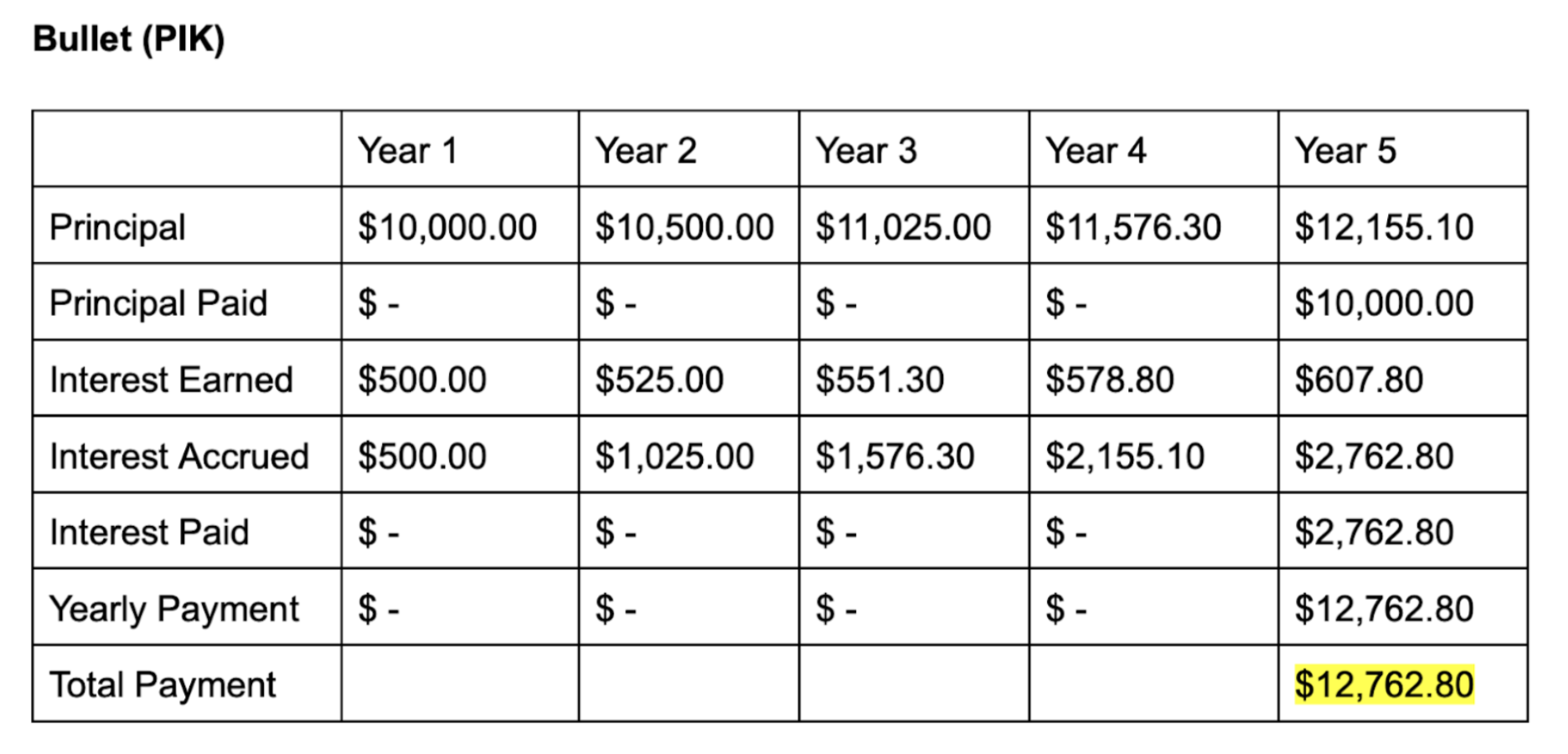
Bullet loans can have deferred interest payments or recurring interest payments. Deferred interest payments are often called Payment in Kind, (“PIK”) interest. PIK interest is deferred and added to the principal balance of the seller note. The interest is then compounding over time.

For example, if the principal balance of the seller note is $10,000 with an annual PIK interest of 5%, the first-year interest expense is $500.

The second year would be $525 because the prior year’s interest payment is added to the principal.

The third year interest would be $551.3 and so forth. Each year, the PIK interest is added to the principal amount and is due at the maturity date.

Bullet with PIK seller note example

Bullet (No PIK)

A bullet note can also include current interest payments rather than PIK interest payments. The original principal is still paid at maturity date, but the interest payments are made annually and do not compound. Using the same example above – a $10,000 seller note with 5% interest – the annual cash interest expense would be $500 each year. In the figure below, the interest is paid annually (or current) to the holder of the seller note.

Bullet without PIK seller note example

Amortization (Straight Line)

The most common method of repaying a bank loan is straight-line principal amortization over the term of the note with regular cash interest.

In simple terms, this means paying a portion of the principal and interest at every installment date. Each principal payment will be the same amount and the interest payment will decline over the life of the loan. Most bank loans with straight line amortization do not include deferred or PIK interest payments.

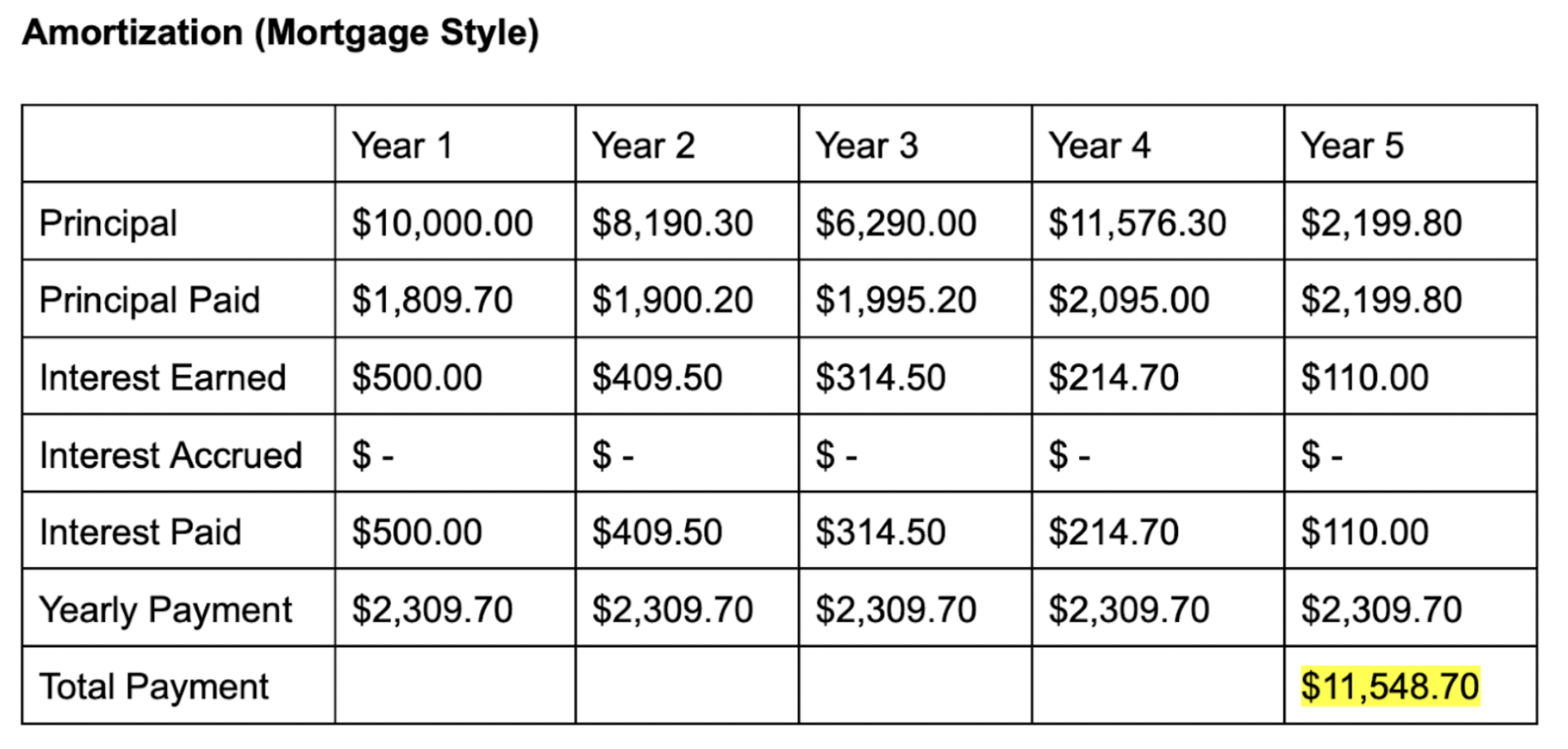
A straight line amortization note contrasts with a mortgage-style note. In a mortgage-style note, each payment amount is the same. While the interest portion decreases over the loan’s lifespan, the portion of principal paid increases.

Most commercial loans, including seller notes, rarely use this method of repayment.

Straight line amortization example

Mortgage style amortization example

Seller notes are most commonly structured as five-year bullet notes with current (no PIK) interest.

Benefits and Risks to the Seller

In small company transactions, the seller benefits from seller notes in many ways:

Benefits to the seller: 

  • Typically, a seller note allows for more flexibility in the acquisition and increases the probability of closing the transaction at a value acceptable to the seller.
  • Receiving interest over the life of the loan will increase the total value received, and the interest is often much higher than what the seller could have received from an upfront cash payment sitting in a bank account.
  • The seller knows the business well and can have confidence they will be repaid.

Where there are benefits to the seller, there are also risks.

Risks to the seller:

  • Most seller notes are unsecured. That means if the business were to fail, and the seller note defaults, there may not be any collateral to cover the seller note. The future performance of the business is unknown and, like for any lender, this presents a risk that the seller note may not be repaid.
  • Seller notes are subordinated to Senior Debt. If the business is not producing enough free cash to cover all of its obligations, then Senior Debt will be prioritized and the seller note may be impaired.

Conclusion

A seller note can be a great option to bridge a valuation or financing gap in a small company acquisition, to “fund” a buy/sell agreement, or to “fund” the sale of a business to a management team. Seller notes benefit both parties and can be structured to meet the unique requirements of the transaction.

However, it’s important to understand the structure as well as the benefits and risks of seller notes.

Do you have further questions about seller notes, or are you wondering how they might fit into the sale of your company? 1719 Partners is here to help— contact us today to get your questions answered.

My last post on acquisition financing covered senior debt. This post will cover Mezzanine debt. Specifically, I’m going to talk about:

  • What is Mezzanine Financing?
  • What is Mezzanine Debt?
  • Mezzanine Debt vs. Senior Debt
  • Mezzanine Debt vs. Equity
  • Mezzanine Debt Uses
  • Mezzanine Debt Interest Rates
  • Mezzanine Finance Structure
  • Mezzanine Debt in Small Company Acquisitions
  • Mezzanine Debt Pros and Cons
  • Sources of Mezzanine Debt

What is Mezzanine Financing?

The word mezzanine is defined as the “partial story or level between two main stories of a building”. 

In this case of a company’s capital structure (those sources of funds used to finance the operations of the business), the two main “finance stories” of a company’s capital structure are senior debt and equity. Mezzanine financing sits between senior debt and equity. 

What is Mezzanine Debt?

Mezzanine debt then is the middle level or “mezzanine” between senior debt and equity.

At the middle level, mezzanine debt is subordinated to senior debt but in a senior position to equity. As such, it is priced between senior debt (as the lowest cost financing) and equity (as the highest). 

Mezzanine debt has both debt-like features and equity-like features. The debt-like features include a principal amount that will be repaid as well as interest to be paid current or deferred through a payment-in-kind structure. The equity-like features allow the provider of the mezzanine debt to participate in the upside of the business, like equity owners, typically through equity warrants.

Mezzanine Debt vs. Senior Debt

Mezzanine debt is more expensive than senior debt because 1) it is subordinate to senior debt (meaning in a liquidation the senior debt lender will be paid in full before the mezzanine lenders sees a dollar) and 2) it typically does not require any principal payment until the end of the term loan. This structure obviously creates more risk for the mezzanine lenders and as a result they charge higher interest rates.

Mezzanine Debt vs. Equity

Mezzanine debt is more expensive than senior debt but is less expensive than equity. Mezzanine debt is less dilutive than raising new equity and allows existing owners to maintain control.

Mezzanine Debt Uses

The unique features of mezzanine debt – mainly payment flexibility and relative risk appetite – make it a nice tool to fund capital requirements in a growing business or in the case of an acquisition. Typical uses of mezzanine debt include: 

  • Recapitalizations
  • Leveraged buyouts
  • Management buyouts
  • Growth capital
  • Acquisitions
  • Shareholder buyouts
  • Refinancings
  • Balance sheet restructuring

However, given the high cost of mezzanine debt, it is important that a borrower ensures it does not have a cheaper source of financing available, is confident in the ability to service the mezzanine debt, and fully understands the terms of the mezzanine loan.

Mezzanine Debt Interest Rates

Mezzanine loans are typically priced anywhere between 15–20%.  There are three main components of mezzanine debt: 1) current interest 2) payment-in-kind (or “PIK”) interest and 3) equity warrants. As mentioned, mezzanine loans are typically interest only with the principal due at the end of a five or seven year term. Current interest payments are typically due monthly or quarterly. For example, a $3 million 15% current pay interest mezzanine loan with a 5 year term would look something like this:

Mezzanine Finance Structure

Mezzanine finance structure example

In some cases mezzanine lenders will PIK (Payment-in-Kind) a portion of the interest payment and add it to the principal amount of the loan. In this case, there will be two buckets of interest: current cash interest and PIK interest. Here is what it would look like if a mezzanine lender offered a $3 million loan with 14% current cash interest and 2% PIK interest:


Mezzanine finance structure example with payment in kind (PIK) interest
Mezzanine debt can also frequently include equity warrants, which are very similar to equity options. Warrants give lenders equity upside when the borrower performs well. Warrants typically represent 1–5% of the fully diluted ownership of the company.

Mezzanine Debt in Small Company Acquisitions

Due to the high-interest rates associated with mezzanine debt, we work with management to pay it off sooner rather than later or to refinance the mezzanine debt with lower-cost senior debt.

If a company is performing well and has plenty of cash, we will use some cash to pay down the mezzanine debt subject to certain prepayment penalties that may apply. 

1719 Partners founder has completed more than 30 acquisitions of small companies.

Many of these acquisitions utilized an appropriate amount of mezzanine debt to fully fund the acquisition.

We typically use 1x–1.5x EBITDA (or cash flow) of mezzanine debt in an acquisition.

So if we buy a company for 5x EBITDA, a typical capital structure might be 2x senior debt, 1x mezzanine debt and 2x equity. 

Our experience shows that 3x total debt (2x EBITDA of senior debt + 1x EBITDA of mezzanine debt) is typically an appropriate amount of debt in a small company acquisition. 1719 typically sources mezzanine debt from mezzanine debt funds where we have long-standing relationships with the principals of the mezzanine debt funds. See below for more information on sources of mezzanine debt.

Pros and Cons

As mentioned previously, mezzanine debt can be a useful tool in the right circumstances. However, it is important that a small business borrower fully understand the implications of this type of financing:

Pros:

  • Less costly than equity
  • More patient capital (no loan amortization)
  • Ability to retain majority control
  • More flexibility than senior debt
  • Alternative capital source with higher risk appetite

Cons:

  • More costly than senior debt
  • May create modest equity dilution through equity warrants
  • Borrower will need to adhere to financial covenants
  • Prepayment penalties may apply

Sources of Mezzanine Debt

Mezzanine debt is primarily available through non-bank lenders such as mezzanine debt funds. Some sophisticated senior bank lenders may also provide mezzanine debt alongside traditional senior debt.

The U.S. Small Business Administration sponsors a program designed to provide capital to small businesses through Small Business Investment Companies (SBICs): 

“An SBIC is a privately owned company that’s licensed and regulated by the SBA. SBICs invest in small businesses in the form of debt and equity. The SBA doesn’t invest directly into small businesses, but it does provide funding to qualified SBICs with expertise in certain sectors or industries. Those SBICs then use their private funds, along with SBA-guaranteed funding, to invest in small businesses.” 

Many mezzanine debt funds are formed as SBICs with a specific focus on providing mezzanine loans to small businesses. A list of SBICs and an overview of the SBIC program is available on the SBA’s website. 

Mezzanine debt can be an important part of financing a small company acquisition, management buyout or growth plan – as the story or level between traditional senior debt and equity. 

Are you considering selling your small company and wondering how 1719 Partners approaches financing an acquisition? Contact us today to learn more.

What is Senior Debt?

Senior debt, also commonly called a senior term loan, is a loan received from a traditional commercial bank that has a specified repayment schedule and either fixed or floating rate interest. 

Through the years we have found that small company owners often don’t have a complete understanding of the types of financing sources used in a small company merger and acquisition transactions. As a result, we would like to do a small blog series to explain the various types of financing sources and address the related sentiments that “debt is bad” and  “private equity firms always over leverage”. 

In this post, we will be covering the following:

  • Traditional Bank Debt
    • Senior Term Loans
    • Revolving Line of Credit
  • Debt is Bad vs. Debt is Good
  • Private Equity Firms and Over Leveraging 
  • How a 1719 Partners Transaction Works 

In general, there are four primary financing sources used in small company M&A transactions: traditional bank debt, mezzanine debt, seller notes, and equity. 

Traditional Bank Debt

We are going to start with traditional bank debt. 

1719 Partners uses two forms of traditional, commercial debt when acquiring a small business: a senior term loan and a revolving line of credit.

Senior Term Loans

Senior debt, also commonly called a senior term loan, is a loan received from a traditional commercial bank that has a specified repayment schedule and either fixed or floating rate interest. Senior debt used in small company M&A transactions is most typically a cash flow-based term loan, which means that instead of lending against physical assets the bank is lending against a company’s consistent cash flow (or EBITDA). 

It is very common for banks to require personal guarantees from business owners when issuing senior term loans to a closely held, private company. These guarantees help protect the bank against the risk of loss associated with poor business performance. 

1719 Partners is able to operate without personal guarantees.

The term (or duration) of a senior term cash flow loan is usually around 5 years.  

The rate of interest for a cash flow term loan is typically higher than an asset based term loan but pricing depends on current market rates and the company’s financial characteristics and performance.  

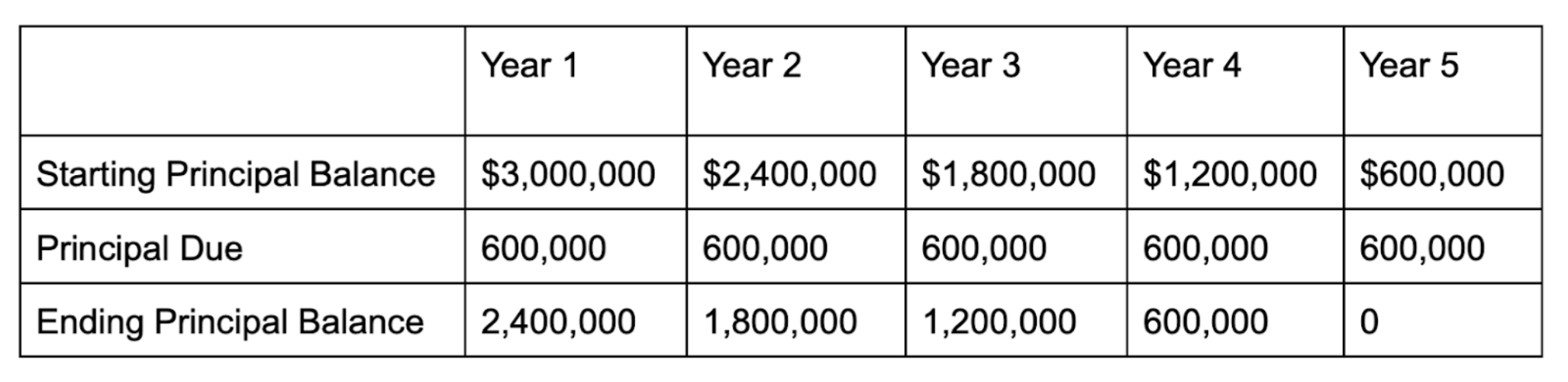
The principal on senior term loans is typically paid in equal monthly (or quarterly) installments over the term. For example here is a typical amortization schedule for a $3 million term loan with a 5 year term:

Example of an amortization schedule for a $3 million loan with a 5 year term

Revolving Lines of Credit

The second type of traditional commercial debt that is commonly used in small company M&A transactions is a revolving line of credit.

A revolving line of credit is an asset-based loan because the bank has a lien on the assets that support the line of credit and it typically advances funds based on a calculated borrowing base tied to specific assets. The two main assets that support a revolving line of credit are accounts receivable and inventory. 

The amount of these assets on a company’s balance sheet dictate the size of the line of credit. The lien on the assets, and the relative ease to realize the lien, typically allow banks to lend the money at lower rates than cash flow term loans.  

Revolving lines of credit tend to have a one year, renewable term. They are called “revolving” because a borrower will frequently borrow against and repay principal balances on a regular basis. Hence, the amount of credit extended or available “revolves” as borrowings and repayments are made. 

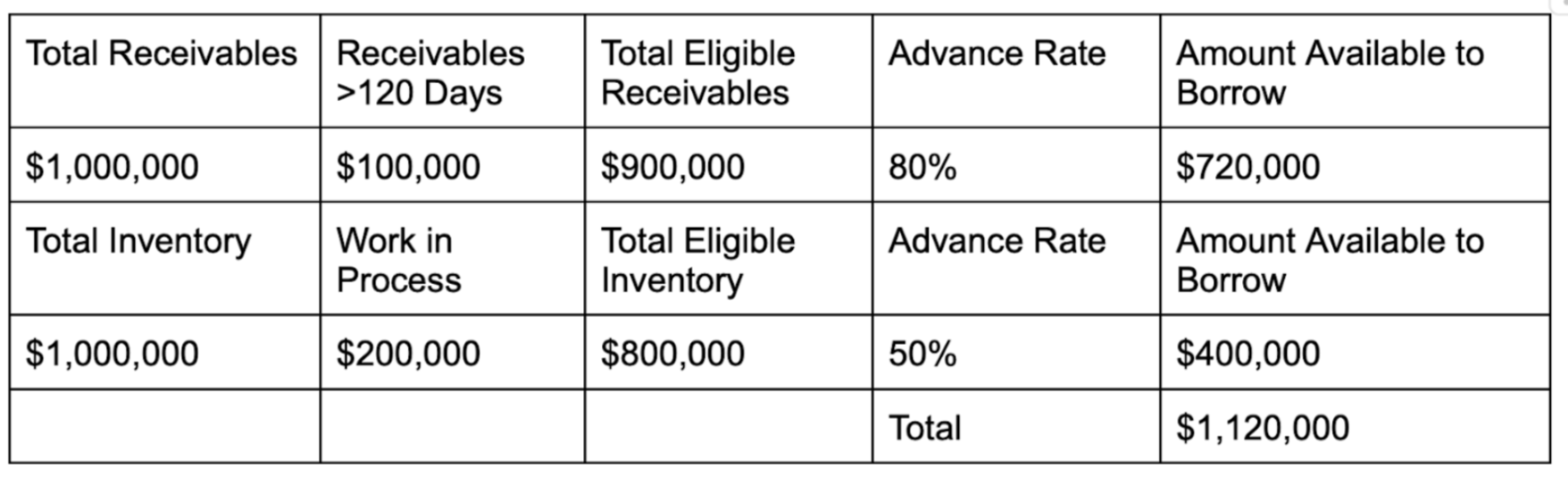
Banks protect themselves when issuing lines of credit by requiring borrowers to submit a borrowing base certificate. The borrowing base certificate determines how much money is available to a borrower on an asset-based revolving line of credit by 1) using advance rates and 2) excluding assets that cannot be turned into cash quickly.  

Advance rates are the amount of money a bank will lend against the face value of an asset. Typical advance rates are 80% on Accounts Receivable and 50% on Inventory. 

Excluding assets from a borrowing base means banks will not lend any money against the asset. A typical exclusion for Accounts Receivables is receivables that are 120 days past due.   A typical exclusion for inventory is “work in process” inventory, meaning inventory that is between raw material and a finished good. 

Below is a simplified version of a borrowing base certificate:

An example of a borrowing base certificate

Debt is Bad vs. Debt is Good

Debt is not inherently good or bad. The perception of whether debt is good or bad is often related to risk tolerance and everyone’s tolerance for risk is different. However, regardless of one’s risk tolerance, it is important to recognize that debt can be an effective tool in small company M&A transactions.

Small company owners are frequently averse to any form of debt because they perceive it to be too risky. And, if the owner is required to personally guarantee the debt, as is frequently the case, this perception of (unacceptable) risk is warranted. 

In small company M&A transactions, debt financing provides a buyer with a source of low-cost financing that benefits the seller. How does a seller benefit from a buyer’s choice of financing? All else being equal, lower cost debt financing will increase a buyer’s return on equity. The higher expected return for a buyer, the more a buyer is willing to pay in an acquisition – to the benefit of the seller. Of course, too much of anything is generally not a good thing. Financing a transaction with 100% debt financing, if available, involves more risk (to the lender and the buyer) than a transaction using only 50% debt financing.

Private Equity Firms and Over Leveraging

This brings us to a conversation about private equity firms and their use of debt (or leverage) in leveraged buyout transactions. There is plenty of press about the use of debt by private equity firms  – much of it focused on how private equity firms use ‘too much’ debt, and invariably involves a story of the resulting failure of an acquired company. There are certainly private equity acquisitions that rely too heavily on debt financing and end poorly. However, the vast majority of private equity transactions use appropriate debt levels.

An analysis of recent middle market leveraged buyout transactions shows Debt/EBITDA ratios of approximately 5.5x. While this debt/EBITDA ratio may be higher than a 1719 Partners acquisition (more on this below), it could be appropriate in a middle market transaction. For context, middle market companies are those with enterprise values between $100 million and $500 million. These are larger companies that likely have deep management teams, robust systems, diverse sources of revenue and strong market positions. These characteristics may support higher amounts of debt than smaller, less developed companies.

How a 1719 Partners Transaction Works

At 1719, our choice of financing sources is designed to provide the business with enough flexibility to grow while optimizing its cost of capital. A typical 1719 transaction will utilize a senior term loan, a revolving line of credit, and equity. Compared to larger M&A transactions, we typically borrow senior debt that represents about twice a company’s annual EBITDA (commonly described as 2.0x Debt/EBITDA). That is, if the target company has $1 million in annual EBITDA, we borrow $2 million in senior term debt. In finance lingo, this is called “2x senior leverage”. 

This amount of debt is much less than in larger transactions (and those transactions that show up in news stories). During strong economic times, large private equity acquisitions may use senior term debt of 7x Debt/EBITDA or more! 

Senior debt is an important source of financing in small company M&A transactions. When used appropriately, it has benefits to both buyer and seller. Determining the “right” amount of senior debt in a transaction is significantly dependent upon the circumstances of the business and the transaction and the risk appetite of the borrower. 

Are you interested in selling your small company, but worried about how a buyer may use debt in the acquisition? We are happy to be a resource; contact us to get your questions answered.