Need-to-Know Financial Information Made Simple

My last post on acquisition financing covered senior debt. This post will cover Mezzanine debt. Specifically, I’m going to talk about:

  • What is Mezzanine Financing?
  • What is Mezzanine Debt?
  • Mezzanine Debt vs. Senior Debt
  • Mezzanine Debt vs. Equity
  • Mezzanine Debt Uses
  • Mezzanine Debt Interest Rates
  • Mezzanine Finance Structure
  • Mezzanine Debt in Small Company Acquisitions
  • Mezzanine Debt Pros and Cons
  • Sources of Mezzanine Debt

What is Mezzanine Financing?

The word mezzanine is defined as the “partial story or level between two main stories of a building”. 

In this case of a company’s capital structure (those sources of funds used to finance the operations of the business), the two main “finance stories” of a company’s capital structure are senior debt and equity. Mezzanine financing sits between senior debt and equity. 

What is Mezzanine Debt?

Mezzanine debt then is the middle level or “mezzanine” between senior debt and equity.

At the middle level, mezzanine debt is subordinated to senior debt but in a senior position to equity. As such, it is priced between senior debt (as the lowest cost financing) and equity (as the highest). 

Mezzanine debt has both debt-like features and equity-like features. The debt-like features include a principal amount that will be repaid as well as interest to be paid current or deferred through a payment-in-kind structure. The equity-like features allow the provider of the mezzanine debt to participate in the upside of the business, like equity owners, typically through equity warrants.

Mezzanine Debt vs. Senior Debt

Mezzanine debt is more expensive than senior debt because 1) it is subordinate to senior debt (meaning in a liquidation the senior debt lender will be paid in full before the mezzanine lenders sees a dollar) and 2) it typically does not require any principal payment until the end of the term loan. This structure obviously creates more risk for the mezzanine lenders and as a result they charge higher interest rates.

Mezzanine Debt vs. Equity

Mezzanine debt is more expensive than senior debt but is less expensive than equity. Mezzanine debt is less dilutive than raising new equity and allows existing owners to maintain control.

Mezzanine Debt Uses

The unique features of mezzanine debt – mainly payment flexibility and relative risk appetite – make it a nice tool to fund capital requirements in a growing business or in the case of an acquisition. Typical uses of mezzanine debt include: 

  • Recapitalizations
  • Leveraged buyouts
  • Management buyouts
  • Growth capital
  • Acquisitions
  • Shareholder buyouts
  • Refinancings
  • Balance sheet restructuring

However, given the high cost of mezzanine debt, it is important that a borrower ensures it does not have a cheaper source of financing available, is confident in the ability to service the mezzanine debt, and fully understands the terms of the mezzanine loan.

Mezzanine Debt Interest Rates

Mezzanine loans are typically priced anywhere between 15–20%.  There are three main components of mezzanine debt: 1) current interest 2) payment-in-kind (or “PIK”) interest and 3) equity warrants. As mentioned, mezzanine loans are typically interest only with the principal due at the end of a five or seven year term. Current interest payments are typically due monthly or quarterly. For example, a $3 million 15% current pay interest mezzanine loan with a 5 year term would look something like this:

Mezzanine Finance Structure

Mezzanine finance structure example

In some cases mezzanine lenders will PIK (Payment-in-Kind) a portion of the interest payment and add it to the principal amount of the loan. In this case, there will be two buckets of interest: current cash interest and PIK interest. Here is what it would look like if a mezzanine lender offered a $3 million loan with 14% current cash interest and 2% PIK interest:


Mezzanine finance structure example with payment in kind (PIK) interest
Mezzanine debt can also frequently include equity warrants, which are very similar to equity options. Warrants give lenders equity upside when the borrower performs well. Warrants typically represent 1–5% of the fully diluted ownership of the company.

Mezzanine Debt in Small Company Acquisitions

Due to the high-interest rates associated with mezzanine debt, we work with management to pay it off sooner rather than later or to refinance the mezzanine debt with lower-cost senior debt.

If a company is performing well and has plenty of cash, we will use some cash to pay down the mezzanine debt subject to certain prepayment penalties that may apply. 

1719 Partners founder has completed more than 30 acquisitions of small companies.

Many of these acquisitions utilized an appropriate amount of mezzanine debt to fully fund the acquisition.

We typically use 1x–1.5x EBITDA (or cash flow) of mezzanine debt in an acquisition.

So if we buy a company for 5x EBITDA, a typical capital structure might be 2x senior debt, 1x mezzanine debt and 2x equity. 

Our experience shows that 3x total debt (2x EBITDA of senior debt + 1x EBITDA of mezzanine debt) is typically an appropriate amount of debt in a small company acquisition. 1719 typically sources mezzanine debt from mezzanine debt funds where we have long-standing relationships with the principals of the mezzanine debt funds. See below for more information on sources of mezzanine debt.

Pros and Cons

As mentioned previously, mezzanine debt can be a useful tool in the right circumstances. However, it is important that a small business borrower fully understand the implications of this type of financing:

Pros:

  • Less costly than equity
  • More patient capital (no loan amortization)
  • Ability to retain majority control
  • More flexibility than senior debt
  • Alternative capital source with higher risk appetite

Cons:

  • More costly than senior debt
  • May create modest equity dilution through equity warrants
  • Borrower will need to adhere to financial covenants
  • Prepayment penalties may apply

Sources of Mezzanine Debt

Mezzanine debt is primarily available through non-bank lenders such as mezzanine debt funds. Some sophisticated senior bank lenders may also provide mezzanine debt alongside traditional senior debt.

The U.S. Small Business Administration sponsors a program designed to provide capital to small businesses through Small Business Investment Companies (SBICs): 

“An SBIC is a privately owned company that’s licensed and regulated by the SBA. SBICs invest in small businesses in the form of debt and equity. The SBA doesn’t invest directly into small businesses, but it does provide funding to qualified SBICs with expertise in certain sectors or industries. Those SBICs then use their private funds, along with SBA-guaranteed funding, to invest in small businesses.” 

Many mezzanine debt funds are formed as SBICs with a specific focus on providing mezzanine loans to small businesses. A list of SBICs and an overview of the SBIC program is available on the SBA’s website. 

Mezzanine debt can be an important part of financing a small company acquisition, management buyout or growth plan – as the story or level between traditional senior debt and equity. 

Are you considering selling your small company and wondering how 1719 Partners approaches financing an acquisition? Contact us today to learn more.
What is Senior Debt?

Senior debt, also commonly called a senior term loan, is a loan received from a traditional commercial bank that has a specified repayment schedule and either fixed or floating rate interest. 

Through the years we have found that small company owners often don’t have a complete understanding of the types of financing sources used in a small company merger and acquisition transactions. As a result, we would like to do a small blog series to explain the various types of financing sources and address the related sentiments that “debt is bad” and  “private equity firms always over leverage”. 

In this post, we will be covering the following:

  • Traditional Bank Debt
    • Senior Term Loans
    • Revolving Line of Credit
  • Debt is Bad vs. Debt is Good
  • Private Equity Firms and Over Leveraging 
  • How a 1719 Partners Transaction Works 

In general, there are four primary financing sources used in small company M&A transactions: traditional bank debt, mezzanine debt, seller notes, and equity. 

Traditional Bank Debt

We are going to start with traditional bank debt. 

1719 Partners uses two forms of traditional, commercial debt when acquiring a small business: a senior term loan and a revolving line of credit.

Senior Term Loans

Senior debt, also commonly called a senior term loan, is a loan received from a traditional commercial bank that has a specified repayment schedule and either fixed or floating rate interest. Senior debt used in small company M&A transactions is most typically a cash flow-based term loan, which means that instead of lending against physical assets the bank is lending against a company’s consistent cash flow (or EBITDA). 

It is very common for banks to require personal guarantees from business owners when issuing senior term loans to a closely held, private company. These guarantees help protect the bank against the risk of loss associated with poor business performance. 

1719 Partners is able to operate without personal guarantees.

The term (or duration) of a senior term cash flow loan is usually around 5 years.  

The rate of interest for a cash flow term loan is typically higher than an asset based term loan but pricing depends on current market rates and the company’s financial characteristics and performance.  

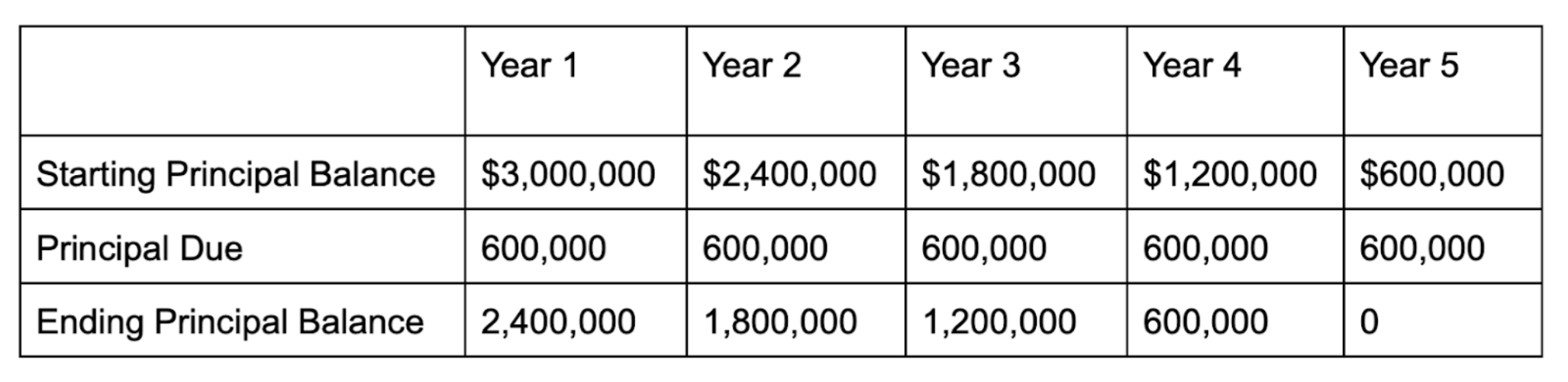
The principal on senior term loans is typically paid in equal monthly (or quarterly) installments over the term. For example here is a typical amortization schedule for a $3 million term loan with a 5 year term:

Example of an amortization schedule for a $3 million loan with a 5 year term

Revolving Lines of Credit

The second type of traditional commercial debt that is commonly used in small company M&A transactions is a revolving line of credit.

A revolving line of credit is an asset-based loan because the bank has a lien on the assets that support the line of credit and it typically advances funds based on a calculated borrowing base tied to specific assets. The two main assets that support a revolving line of credit are accounts receivable and inventory. 

The amount of these assets on a company’s balance sheet dictate the size of the line of credit. The lien on the assets, and the relative ease to realize the lien, typically allow banks to lend the money at lower rates than cash flow term loans.  

Revolving lines of credit tend to have a one year, renewable term. They are called “revolving” because a borrower will frequently borrow against and repay principal balances on a regular basis. Hence, the amount of credit extended or available “revolves” as borrowings and repayments are made. 

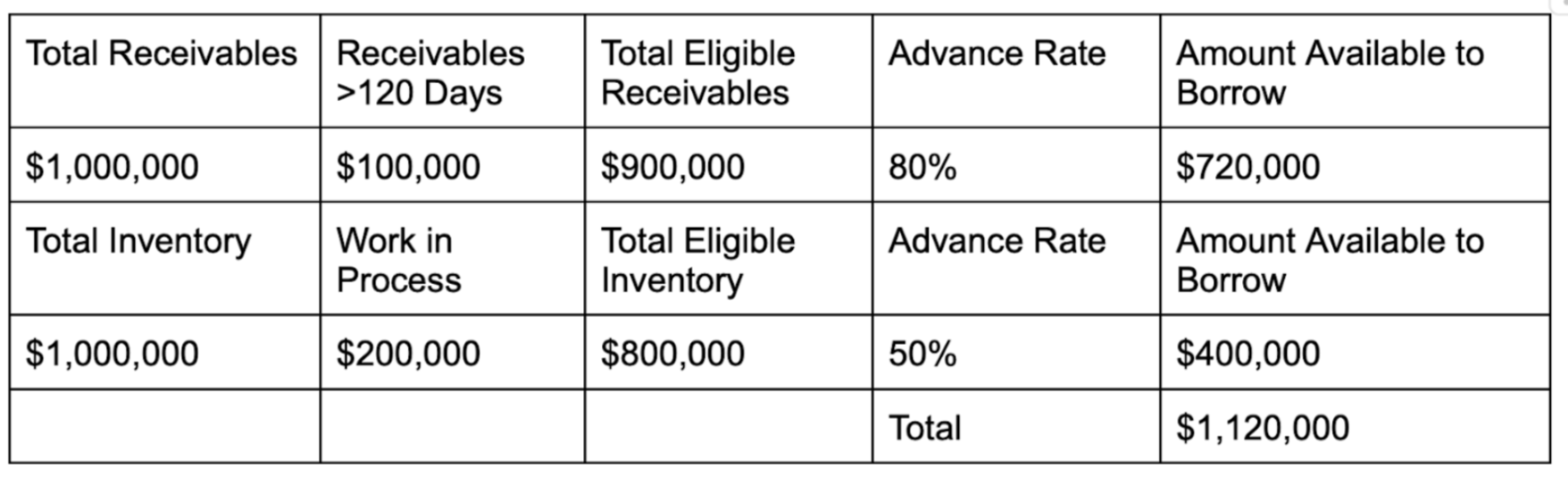
Banks protect themselves when issuing lines of credit by requiring borrowers to submit a borrowing base certificate. The borrowing base certificate determines how much money is available to a borrower on an asset-based revolving line of credit by 1) using advance rates and 2) excluding assets that cannot be turned into cash quickly.  

Advance rates are the amount of money a bank will lend against the face value of an asset. Typical advance rates are 80% on Accounts Receivable and 50% on Inventory. 

Excluding assets from a borrowing base means banks will not lend any money against the asset. A typical exclusion for Accounts Receivables is receivables that are 120 days past due.   A typical exclusion for inventory is “work in process” inventory, meaning inventory that is between raw material and a finished good. 

Below is a simplified version of a borrowing base certificate:

An example of a borrowing base certificate

Debt is Bad vs. Debt is Good

Debt is not inherently good or bad. The perception of whether debt is good or bad is often related to risk tolerance and everyone’s tolerance for risk is different. However, regardless of one’s risk tolerance, it is important to recognize that debt can be an effective tool in small company M&A transactions.

Small company owners are frequently averse to any form of debt because they perceive it to be too risky. And, if the owner is required to personally guarantee the debt, as is frequently the case, this perception of (unacceptable) risk is warranted. 

In small company M&A transactions, debt financing provides a buyer with a source of low-cost financing that benefits the seller. How does a seller benefit from a buyer’s choice of financing? All else being equal, lower cost debt financing will increase a buyer’s return on equity. The higher expected return for a buyer, the more a buyer is willing to pay in an acquisition – to the benefit of the seller. Of course, too much of anything is generally not a good thing. Financing a transaction with 100% debt financing, if available, involves more risk (to the lender and the buyer) than a transaction using only 50% debt financing.

Private Equity Firms and Over Leveraging

This brings us to a conversation about private equity firms and their use of debt (or leverage) in leveraged buyout transactions. There is plenty of press about the use of debt by private equity firms  – much of it focused on how private equity firms use ‘too much’ debt, and invariably involves a story of the resulting failure of an acquired company. There are certainly private equity acquisitions that rely too heavily on debt financing and end poorly. However, the vast majority of private equity transactions use appropriate debt levels.

An analysis of recent middle market leveraged buyout transactions shows Debt/EBITDA ratios of approximately 5.5x. While this debt/EBITDA ratio may be higher than a 1719 Partners acquisition (more on this below), it could be appropriate in a middle market transaction. For context, middle market companies are those with enterprise values between $100 million and $500 million. These are larger companies that likely have deep management teams, robust systems, diverse sources of revenue and strong market positions. These characteristics may support higher amounts of debt than smaller, less developed companies.

How a 1719 Partners Transaction Works

At 1719, our choice of financing sources is designed to provide the business with enough flexibility to grow while optimizing its cost of capital. A typical 1719 transaction will utilize a senior term loan, a revolving line of credit, and equity. Compared to larger M&A transactions, we typically borrow senior debt that represents about twice a company’s annual EBITDA (commonly described as 2.0x Debt/EBITDA). That is, if the target company has $1 million in annual EBITDA, we borrow $2 million in senior term debt. In finance lingo, this is called “2x senior leverage”. 

This amount of debt is much less than in larger transactions (and those transactions that show up in news stories). During strong economic times, large private equity acquisitions may use senior term debt of 7x Debt/EBITDA or more! 

Senior debt is an important source of financing in small company M&A transactions. When used appropriately, it has benefits to both buyer and seller. Determining the “right” amount of senior debt in a transaction is significantly dependent upon the circumstances of the business and the transaction and the risk appetite of the borrower. 

Are you interested in selling your small company, but worried about how a buyer may use debt in the acquisition? We are happy to be a resource; contact us to get your questions answered.

Earlier this week, I had a long conversation with an owner of a small business regarding his annual draw and how this draw, unlike a salary, is not reflected in his company’s income statement and why the difference is important in valuing a small business. This issue frequently arises when a small business owner is involved in running her company and someone needs to fill her role (whether the owner or someone new) when she sells the business. Below we go into owner’s draw vs salary and how it works in practice.

Owner’s Draw vs Salary: the Difference

A salary is a wage that is paid to an employee (whether an owner or not). Salary is an expense that is deducted from revenue to arrive at net income as reported on the income statement.

A draw is a cash distribution paid to a business owner and reflected on the balance sheet as a reduction in cash and a reduction in shareholders equity. A draw is not reflected on the income statement and has no impact on net income.

Below is a simple income statement that reflects the accounting treatment of the owner’s draw vs salary.

Chart of income statement that shows owner's draw vs salary

The difference between owner’s draw vs salary is important in valuing a small business because most businesses are valued based upon a multiple of earnings. If an owners’ compensation is not included as a salary expense, but rather taken as a draw, it will artificially increase earnings and, thus, valuation. The table below illustrates this valuation impact.

Table demonstrating how owner's draw vs salary impacts company valuation.

If an owner’s compensation is paid via a draw, it will not be included in her company’s earnings so we must adjust her company’s income statement to reflect this expense, reducing earnings. The reduced level of earnings is now reflective of the earnings a new owner will receive from operating the business. And, since most businesses are valued based on a multiple of earnings, this will adjust the valuation of the company. 

Do you have any questions about owner’s draw vs salary, or are curious how business valuations work? Feel free to contact us, we are always happy to have a conversation.

Small business owners are often apprehensive about the changes that may occur when their business is acquired. When 1719 Partners acquires a company we do not immediately look to change the business. However, depending on the company’s current financial systems, financial reporting is something that may change after the deal closes. This typically means two changes for a business: 1) monthly reporting is completed in a more timely manner and 2) additional financial reporting is required.

Timely Monthly Reporting

1719 Partners receives monthly financials (income statement and balance sheet) from our portfolio companies within 30 days after the month’s end. Most small businesses are not used to producing monthly financials this quickly. While this can be an adjustment, companies eventually see the benefits of timely reporting. It is much easier for all parties to manage a business when you have timely data.

Additional Financial Reporting

All of our companies have a revolving line of credit to manage working capital. A line of credit is supported by a borrowing base certificate. A borrowing base lists a company’s eligible accounts receivable and inventory and dictates how much the company can borrow. Many small businesses are not accustomed to providing monthly accounts receivable aging reports and monthly inventory reports. However, the benefits of access to additional capital (via a line of credit) are greater than the administrative burden of creating these reports.

Financial Covenant Calculations

Banks and mezzanine lenders use financial covenants to monitor the performance of a borrower. These lenders request quarterly financial covenant calculations from the borrower. Financial Covenants give the lenders a heads up if the financial standing of the borrower has changed over a given period of time. For example, one common financial covenant is Total Leverage. The Total Leverage covenant measures the Total Debt (senior debt + mezzanine debt) in relation to the trailing twelve months (TTM) of EBITDA. 

So, if the Total Leverage covenant requires that Total Debt must be less than 4.0x TTM EBITDA, the borrower has to perform this calculation each quarter and send the results to the lender in a covenant compliance certificate. If the Total Leverage is less than 4.0x then the borrower is in compliance with the covenant. However, if Total Leverage goes above 4.0x, the borrower is not in compliance and the lender will want to sit down with the borrower and understand why things have changed. Covenant calculations are not difficult, but most small businesses are not used to completing them so it can take some time getting used to.

Individually none of these financial reporting requirements are a big deal, but we understand that collectively it can feel like a burden. One of the things that sets 1719 Partners apart is how we work with you during this transition. We help make the process as efficient as possible, using our wealth of experience to guide companies. This allows us to give our companies access to additional capital while cutting out the accounting headache. If you would like to learn more about our process or are interested in working together, please contact us.

Business investment can take many forms: hiring or enhancing personnel, purchasing equipment, expanding IT systems, etc. Each business is different and has different needs at different times. We understand the importance of ongoing investment and have experience guiding a variety of company types toward their business goals.

Over the years 1719 Partners founder Scott Dickes has advised dozens of private company investments from multi-million capital equipment purchases at Custom Label to add-on acquisitions at JRI Industries.

Occasionally you hear private equity horror stories: private equity owners that stop investing in their companies, strip them of assets, and sweep every penny out of the business. That strategy may boost cash-flow in the short term, but 1719 Partners is not in the business of making short-term investments. We are dedicated to creating true long-term value for many years— even decades— to come, and this focus guides all our investment decisions. 

Therefore, we recognize not only the importance of ongoing investment, but also of making the right investments at the right times. Investing for a company’s long term growth prioritizes company health above making a quick profit. That focus is how we set the company up for continuous success. If you would like to learn more about our thoughts on investing and growth, please contact us to have a conversation.

Using debt (borrowing) to finance a leveraged buy-out is often maligned by the media or politicians and frequently positioned as risky, destructive, or even dangerous. Others view the tax deductibility of interest payments to be unfair or bad for society. (I never hear these same people saying the taxes paid on interest income to be destructive or bad for society – but that is a discussion for another post.)

Sayings like: “Neither a borrower nor a lender be” ring true to many people. Great Americans like Benjamin Franklin and Andrew Jackson have been quoted as saying “I’d rather go to bed supperless than rise in debt” and “when you get in debt you become a slave.”

1719 Partners believes that debt, when properly used, is an important and useful tool. If the capital structure is poorly organized and if the business unexpectedly underperforms, leverage can compound problems. But if done right, there are benefits to leverage.

[Note: This post does not look at the negatives of leverage or how to determine the proper capital structure. This post simply looks at the benefits of leverage assuming that it is the right capital structure and that the business performs to expectations.]

As proponents of leverage, 1719 Partners sees four main benefits of using term debt to finance a portion of a transaction’s purchase price.

Benefit #1: Interest Tax Shields

Because interest expense is deductible for income tax purposes, paying interest lowers your income tax liability. Sophisticated financiers can determine the expected net present value of the income tax shield associated with the interest payments.

While a 1719 Partners’ portfolio company gets to deduct the interest tax expense, it is important to note that this benefit does not really accrue to the portfolio company– it generally accrues to the person who sold the business to 1719 Partners. Why? Because the tax deductibility of interest payments is universal and available to all buyers. Since all buyers have access to the value of the interest tax shield, all buyers are willing to increase their purchase price by a like amount. So the interest tax shield benefits accrue to the business seller. Don’t believe me? There are many excellent academic studies confirming this point. Here is an abstract from an Oxford Business School study for your enjoyment.

“Tax savings associated with increased levels of debt are often thought to be an important source of returns for private equity funds conducting leveraged buyouts (LBOs). However, as leverage is available to all bidders, the vendors may appropriate any benefits in the form of the takeover premium. For the 100 largest U.S. public-to-private LBOs since 2003, we estimate the size of the additional tax benefits available to private equity purchasers. We find a strong cross-sectional relationship between tax savings and the size of takeover premia; and on average the latter are around twice the size of the former. Consequently, the tax savings from increasing financial leverage essentially accrue to the previous shareholders rather than the private equity fund that conducts the LBO. It is, therefore, unlikely that (ex ante predictable) tax savings are an important source of returns for private equity funds. Furthermore, policy proposals that aim to restrict leverage or the tax deductibility of debt are likely to have their impact mainly on existing owners of companies.”

Benefit #2: Less Equity At Risk – So Equity Returns Can Be Higher

This is just simple math. Let’s assume you buy a company for $2 and sell it for $3 in 5 years. (To make this problem simpler, let’s also assume there are no distributions at all during the 5 year period and that the debt is not amortized.) If you financed this transaction with 100% equity, you generated a 50% return over five years, or an annualized return of about 8.5%.

Now, let’s assume that when you buy the company for $2, you borrow $1.50 from a bank and invest $0.50 in equity. When you sell the company in 5 years for $3, you take $1.50 of the proceeds and pay back the bank, leaving $1.50 for the equity owners. Since you invested $0.50 and the equity is now worth $1.50, this is a 200% return over 5 years, or an annualized return of about 24.5%.

Obviously a 24.5% annual rate of return is significantly better than an 8.5% annual rate of return.

Benefit #3: Debt Reduces Bad Decisions by Management/Governor on Cash

While 1719 Partners provides active oversight of its portfolio companies, it does not manage any of its companies on a day to day basis. Day to day management of each business is the responsibility of our partners managing the business.

We implicitly trust our partner management teams and we believe we have some of the best operators out there running our companies. However, we also believe that the obligation to meet a defined principal amortization schedule is an excellent motivational tool and helps management teams prioritize uses of capital. Projects with a potentially low rate of return are not funded– only the best uses of capital receive funding.


Benefit #4:  Portfolio Company Lenders Are Our Partners– Deal Confirmation

1719 Partners has established many excellent and long-term relationships with debt financing partners. We view these organizations as our partners in each transaction. If we are excited about a deal, 9 times out of 10, so are our debt partners. However, occasionally our lending partners balk at a transaction we find attractive. We trust our financing partners and we know they have good judgment. If they don’t like a deal it makes us ask what they see that we don’t. While we can still complete the transaction without them (either by finding other lenders or putting in more equity) we have learned over the years that supportive lenders usually signal a good transaction.

Would you like to learn more about our approach to debt? Feel free to contact us.