Need-to-Know Financial Information Made Simple

An asset based working capital line of credit— or revolver— provided by a lender typically incorporates a provision called a “borrowing base”. A borrowing base is a calculated dollar value that sets the upper limit on how much money the company can borrow from its lender on the line of credit. This borrowed working capital is used to fund ongoing business operations, such as purchasing inventory needed for later sales, or to finance accounts receivable. Understanding how a borrowing base works is important for understanding how high your working capital line of credit could be. We also discuss how a working line of credit may be used in acquisitions.

What is a Borrowing Base?

A borrowing base, in simple terms, defines how much money an asset based lender is willing to loan a company. The borrowing base is calculated based on the value of the company’s assets used as collateral. However, determining the collateral value of those assets is not as simple as taking the book value. A portion of the assets may be excluded, and the lender also applies a discount factor, known as an advance rate. We will detail how to calculate a borrowing base in this post.

Collateral Types

Different types of assets can be used as collateral, such as accounts receivable, inventory, or equipment. Larger assets such as property are typically not used as collateral for a working capital line of credit. Such assets are more fitting for long term debt, like a house in a mortgage for example. In general, assets that hold value over an extended period of time— and decline in value predictably— are paired with long term debt, while assets with temporary value are paired with short term debt.

Borrowing Base Calculation

The borrowing base calculation begins with the book value of accounts receivable and inventory. Next, certain ineligible assets (as defined in the credit agreement) are removed. Finally, the value of remaining eligible assets is then multiplied by the advance rate, or the portion of the assets the lender is willing to lend against. The advance rate for accounts receivable is typically 80%, and the advance rate for inventory is usually 50%. Then these two separate values are added together to determine the borrowing base amount.

For example, if a company’s eligible accounts receivable balance is $1.6 million, then calculating the accounts receivable portion of the borrowing base looks like this:

1,600,000 x .8= 1,280,000

And if the value of the company’s eligible inventory is $1.0 million, then calculating that portion of the borrowing base looks like this:

1,000,000 x .5= 500,000

To calculate the final borrowing base value, both portions are added together:

1,280,000 + 500,000 = 1,780,000

In this situation, the company’s borrowing base would be $1,780,000. The question then becomes, what assets are ineligible?

Ineligible Accounts

Unless deemed ineligible, the borrowing base calculation includes all inventory and accounts receivable. Generally, ineligible accounts are ones the lender views as risks on the ability of the borrower to convert to cash.

Old Accounts Receivable

When a company sells with credit, it is normal for invoices to take some time to get paid. While due in 30 days is common, some accounts receivable can creep into the 60-90 day range. When an account ages past 90 days, it can signal distress on the customer and indicate uncertainty that the customer will pay the balance. 

While it depends on the lender’s risk tolerance, most lenders will remove the entire account associated with the late payment. So if a customer has not paid a balance in 90 days, the full account associated with that customer would be removed from the borrowing base.

Customer Concentration

The more diverse group of buyers a company has, the less harmful it will be if one customer stops doing business with the company. As soon as a sizable amount of business is concentrated to one or a select few customers, the lender will be wary. This is because if a large customer fails to pay, the company’s accounts receivable balance will drop significantly, and the lender may have advanced funds based on this collateral. Now the lender will be in an over-advanced position and might require the borrower to immediately reduce the outstanding balance on the line of credit to bring it back in compliance with the borrowing base.

To reduce exposure to this risk, banks will often set a customer concentration limit, say at 25%. If a customer makes up 40% of the company’s accounts receivable, for example, 15% of the balance would be removed from the borrowing base.

Unsellable Inventory

As inventory value makes up some of the borrowing base, the ability for the inventory to be sold must be monitored. Sometimes inventory proves to be obsolete, excessive, or otherwise unsellable, while the company could still be including this inventory’s value on its balance sheet. For the inventory balance to be accurate, the company would need to remove the value of the unsellable inventory. 

To mitigate this risk, the lender may conduct site visits— to the company’s warehouse for example. This is to ensure undesirable inventory is not piling up somewhere. In addition to site visits, lenders will watch for trends in inventory sales. For example, if inventory’s time in the warehouse is typically short-lived but becomes much longer, the lender may start asking questions. 

One strategy to protect against future obsolescence is the use of inventory caps. Inventory caps are based on past sale trends: if a company typically only sells a certain portion of its inventory while the rest ages out, the value of the aged out portion would not be included in the borrowing base. The inventory cap is an estimate based on projected future performance. For example, the bank may exclude inventory that is in excess of one year sales.  As a result, the portion of included inventory could be very different from the company’s inventory book value.

Government Accounts

Any balances associated with the Federal government are typically not included in the borrowing base. This is because the company cannot sue the government for any outstanding balances.

Borrowing Base Certificate

Over time, a company’s borrowing base must be monitored. A borrowing base certificate is a formal document that governs how the borrowing base will be re-calculated over time. In other words, it sets the terms for the loan and the amount that can be advanced. Because a company’s inventory and accounts receivable fluctuate often, the borrowing base may need to be calculated often. 

For the lender to monitor the borrowing base, the borrower is required to supply an accounts receivable and inventory record at regular intervals. Such monitoring ensures the lender is only advancing what can be backed by its assets.

Borrowing Base and Acquisitions

Can a working capital line of credit be used to finance an acquisition? A line of credit is typically not an appropriate financing source for acquisitions. As discussed earlier in this post, larger assets with predictable long-term value are better suited as collateral for longer term loans. Thus, term debt should make up a large portion of an acquisition, for example 50%. If a working capital line of credit is used to finance an acquisition, it is typically a very small portion— like five to ten percent of the total sources of funds.

1719 and Acquisitions

When 1719 Partners completes an acquisition, we always have a working capital line of credit to ensure business operations can continue as usual. We recognize that this is necessary to fund a business’s liquidity needs. As mentioned above, 1719 does not rely on a line of credit to finance an acquisition; most of the financing is supplied by term debt and our equity investment. 

If you have any questions on how a borrowing base works, or about using a working line of credit in acquisitions, we would be happy to help. Simply contact us and we will be in touch.

When a business owner is looking to sell their company, making sure the business remains in good hands is often a priority. It can be hard to trust that the buyer will carry on the company’s legacy and provide for future success. In these cases, a management buyout can ease the owner’s concerns and help ensure a smooth transition from seller to buyer.

In a management buyout, the existing management team purchases the company from the owner or owners. Compared to other potential buyers, the management team knows much more about the company, and the seller is also familiar with the management team. This can make selling to the management team attractive to the business owner, as it is likely the company’s success will continue under the new leadership.

What Is a Management Buyout?

Simply put, a management buyout is when the existing management team “buys out” the owner(s) and acquires the company. If the management team uses debt to help finance the acquisition, the management buyout (or MBO) is called a leveraged management buyout, because it is a leveraged buyout (or LBO) transaction. As an LBO, management buyouts are funded mostly with borrowed capital, and, frequently, seller financing is used for a portion of the total consideration.

Management buyouts can occur when the company owner is ready to retire or the management team wants to take on more responsibility. The management team may want to make more leadership decisions, obtain greater financial benefits, or simply take the company to new heights of growth. The management team may feel they have the expertise necessary to guide the company to greater success, and that the most efficient way to do so is through a management buyout. It also is a way for management to have a larger stake in company success, by moving from “employee” to “owner” and sharing in the profits generated by the business.

The Management Buyout Process

Typically management buyouts are directly negotiated transactions between the business owners and the management team. It is rare to see the management team participating in a competitive situation— with multiple buyers— as most buyers want to work with an existing management team, and not bid against them. For this reason, should an owner want to sell in an auction process, the management team is commonly not allowed to participate as a buyer.

A successful management buyout may take years to culminate from the initial conversations to a closed transaction. First the owners or the team must approach the other party, then both parties must discuss valuation and deal structure. After that, they have to agree on terms, and the management team must secure necessary financing— all while everyone is still running the business. Needless to say, this process can be lengthy. As the management team often does not have the capital necessary to purchase the company, arranging for financing— both equity and debt— is usually a challenge. The management team also may conduct due diligence, but it is far less extensive than if an external buyer were to acquire the company.

Advantages and Disadvantages

As stated earlier, management’s knowledge of the company can offer many benefits. Due to this familiarity, the due diligence process is much quicker. There also may be a greater potential for future success, as management is able to assume ownership and hit the ground running. In contrast, it would take time and money to educate an external buyer on the company— and therefore, take longer to build company success. The transition can benefit employees, as well; as management rises to ownership, advancement opportunities open up. Another benefit is the assumption that the business will be run as before, which is good for maintaining employee and customer trust.

As positive as an MBO can be, conflicts can also arise. The previous owners may struggle to hand the baton to management and transfer control. At the same time, the transition from manager to owner can be challenging for the new owners, especially if they have no past ownership experience. Naturally, owning a business is different from a managerial role and this learning curve can be steep.

When it comes to purchase price, a seller may receive less than if the transaction occurred with a competitive auction. But the seller may prefer this for several reasons: they like the managers and want them to be owners, the sale process is less disruptive than a drawn out auction which includes management meetings, site visits, etc., and selling to the management team helps solidify the legacy and customer continuity versus selling to a competitor.

Management Buyout vs. Management Buyin

The opposite of a management buyout is a management buyin (MBI). In a management buyin, an external management team purchases all or the majority of a company. This is an option when the company is lacking a successor. In these situations, a new management team can provide much-needed guidance to stimulate business growth. Likewise, a succession solution enables the company to continue thriving. A MBI opportunity can be attractive to buyers, as well: the new owners have the opportunity to grow the company and create significant value for themselves.

Financing a Management Buyout

Oftentimes, the management team does not have the funds necessary to acquire the business. As stated earlier, financing the transaction is usually the hardest part of an MBO. From debt financing with banks, to seller financing, to partnering with a private equity firm, there are a variety of financing options.

Debt Financing

One option is borrowing from a bank. Typically with debt financing, the management team is expected to provide most of the capital, with the bank filling the gap. The problem is banks often view an MBO as too risky, and may not be willing to lend the funds. Banks also look for collateral and/or personal guarantees— both of which might be lacking or insufficient.

Seller Note

The previous owner may be willing to issue a seller note, which allows the buyer to repay a portion of the purchase price over an extended period. Thus the financing will come out of the business’s future success, bridging the gap between the full purchase price and what the management team is currently able to finance themselves or with a traditional senior loan.

Mezzanine Debt

Another option is mezzanine financing. Although mezzanine financing comes with higher interest rates, it is a way to obtain capital without the backing of collateral. Because mezzanine debt is more expensive than senior debt, it often complements other methods of primary financing.

Private Equity and Management Buyouts

When a bank is reluctant to lend capital, partnering with a private equity firm to complete the buyout can be a good option. Private equity firms have capital and relationships with debt providers to help finance the transaction. Once the transaction is complete, private equity firms can offer support for business operations.

However, it is important to investigate the private equity firm before initiating a partnership to make sure the firm and the buyer’s goals are aligned. When the firm and the new owners are working together toward a common goal, the company can reach new levels of growth.

 F/S Manufacturing and 1719 Partners

F/S Manufacturing is an agricultural equipment supplier specializing in designing, manufacturing, and assembling top-quality liquid material handling equipment. This specialty equipment includes sprayers, mixing tanks, liquid or fertilizer storage tanks, hose reels, tenders, and trailers. Since its founding in 1990, the company has been a trusted resource for the agricultural industry’s needs.

F/S Manufacturing’s senior management had worked at the company for a long time and knew the company very well. When they wanted to become owners, they partnered with 1719 Partners to facilitate the management buyout. 1719 is excited to support the new owners and take the company to even greater success. We believe the company is positioned to expand its product line beyond the current offerings, and we look forward to seeing F/S grow.

Final Thoughts

Management buyouts can be intimidating and complex, but with the right strategy they have a high potential for success. Open communication between the buyer and seller as well as the buyer with any partners is important for a successful MBO. Partnering with an experienced buyer of small businesses can increase the chance of a great outcome. If you are considering a management buyout or have questions about the process, 1719 is happy to help. Contact us to be in touch.

The working capital adjustment is an important part of most merger and acquisition (M&A) transactions. A working capital adjustment adjusts the purchase price of the company based on the actual working capital delivered at closing. If working capital is above the working capital target, the purchase price increases, and if the working capital at closing is below the target amount the purchase price decreases. While this might sound like there is a “winner” and a “loser,” when properly structured, working capital adjustments are buyer-seller neutral.

Holistically, the working capital adjustment helps make sure the company’s operations run as usual from the deal’s early stages up until closing. Without working capital adjustments in place, the seller could manipulate the balance sheet, causing the buyer to pay more in the transaction. Likewise, if the balance sheet strengthens between the letter of intent (LOI) stage and closing, the buyer would get this benefit without paying for it. The working capital adjustment resolves these conflicts.

There are three key components to a successful working capital adjustment: how do you define working capital, what is the target working capital value, and closing estimate and post-closing true-up.

What is Working Capital and How to Set a Working Capital Target

Defining working capital itself is the foundation of a working capital adjustment. In simple terms, working capital is a company’s current assets subtracted by its current liabilities. Cash, inventory, unpaid invoices, and accounts receivable are examples of a company’s assets. Liabilities include accounts payable, short-term debt payments, unpaid wages to staff, and more. Working capital gives insight into a company’s short-term financial health and operational efficiency. Generally, higher working capital indicates success and a positive outlook: that the company has the extra cash to invest in growth or take on opportunities. Conversely, negative working capital could indicate that the business is struggling to grow or pay back debts, or even is at risk of bankruptcy. Put in an equation, working capital looks like:

Working Capital = Current Assets – Current Liabilities

However, every business is unique, and most transactions are structured as cash-free and debt-free. A business might be seasonal, or it could include percentage of completion accounting. A successful working capital adjustment begins with the buyer and seller agreeing on exactly what should be included— and excluded from the definition. Early on in the acquisition process, the buyer and seller determine how much working capital is necessary to maintain healthy business operations. This figure is frequently defined during the letter of intent (LOI) stage, wherein the terms of the deal are outlined in a legally non-binding document. This working capital amount is sometimes redefined during the due diligence stage of the acquisition process, when the buyer investigates the business more thoroughly.

After agreeing upon the working capital definition, the next step is agreeing on the target value. If the business is perfectly stable, this is easy to do: just take the current working capital value and set that as the target. However, some businesses are seasonal, or have other variables. For these businesses, calculating working capital— as defined— at month end for each of the previous twelve months, and averaging the value, is often a good methodology to set the target value.

In its simplest form, working capital and its target could resemble the chart below.

Working Capital Definition and Value at LOI Date:

example of a working capital target calculation, crucial to calculating the working capital adjustment

Working Capital Adjustment and How It is Calculated

When it is time for an acquisition to close, an estimated working capital adjustment is typically made at closing with a final true-up typically completed 90 to 120 days after closing— allowing the buyer and seller time to review and agree upon the estimated closing adjustments.

Below is an example of a working capital adjustment calculation. In the example below, the working capital delivered at closing is more than the target working capital decided upon at the LOI stage. As a result, the purchase price increases by the excess— in this case, $115,000. While the buyer pays more, the buyer also receives the additional working capital when business ownership begins. At the same time, the seller receives compensation for what they invested into working capital, ensuring they are paid the full purchase price.

Working capital adjustment calculation example

Protecting Both the Buyer and the Seller

So, why is a working capital adjustment important? Without a working capital adjustment, the buyer risks paying more than the purchase price to cover the company’s lack of working capital. For example, if the seller were to “forget” to pay its bills, the company’s cash would increase but its working capital would decrease. The working capital adjustment protects the buyer from having to pay these bills in addition to the full purchase price. The adjustment also motivates the company to pay its bills as it normally would, as manipulating the balance sheet will not change the seller’s compensation. Effectively, working capital adjustments help ensure the company is run as usual from the letter of intent stage up until closure.

While in the example above it may look like the seller receives an additional $115,000 of consideration, the seller is actually neutral on the adjustment, as the table below shows.

Why Seller is Neutral Between LOI and Closing:

Calculation demonstrating how the seller is neutral on the working capital adjustment

Working capital adjustments are crucial to ensuring the acquisition process runs smoothly. If you have any questions about working capital adjustments, do not hesitate to reach out.

Over the past several years, a new investment vehicle has become prominent in PE investing: the fundless sponsor. What is a fundless sponsor? At the most basic level, unlike traditional committed capital PE funds, fundless sponsors are PE investors who set out to identify and invest in businesses without the prearranged backing of committed capital. This lean model provides several benefits to the general partner and the investors. As this model has gained popularity, two distinct investment vehicles have emerged: the independent sponsor and the search fund.

Independent Sponsors

An independent sponsor in private equity refers to an individual or a small team of investors who source, negotiate, and structure acquisitions of companies without having a committed fund under management. Instead of managing a pool of capital from limited partners like traditional PE firms, independent sponsors typically raise equity on a deal-by-deal basis from a network of high-net-worth individuals, family offices, or institutional partners once they’ve identified a target company. In addition, the independent sponsors typically arrange for all debt financing necessary to complete the acquisition.

At first glance, the independent sponsor model provides desirability due to its flexibility, fee structure, and deal-by-deal capital raising basis. The model offers several unique benefits compared to traditional private equity, which appeal to sponsors and the investors who back them.

1. Greater Flexibility

  • For Sponsors:
    • Deal-by-Deal Focus: Independent Sponsors reserve the right to pursue investment opportunities on a case-by-case basis. They are not bound to the pressures of deploying committed capital within a specific time horizon. As a result, independent sponsors can be more intentional, “cherry-pick” the best opportunities, and pass on the less attractive ones.
    • Longer Hold Periods: Because Independent Sponsors are not held to the traditional fund lifespan of ~7 to 10 years, they can be more patient and hold investments for longer, leaving no value behind at the time of a liquidation event.
      * Investment returns are not commingled.
  • For Investors:
    • Deal Specificity: Investors can choose exactly which opportunities to invest in, allowing them to align more directly with their strategic goals.
    • Smaller Capital Committed: Investors can write smaller checks on a per-deal basis, as opposed to the large commitments typically required by traditional PE funds.

2. Lower Management Fees

  • Closing Fees: Traditional PE firms follow the 2 and 20 fee structure (annual management fees of 2% of committed capital and 20% carried interest on investments). Because independent sponsors don’t manage a pool of committed capital, they forgo the 2% fee. Instead, they earn a closing fee when deals are executed, often a percentage of the transaction, ranging from 1.5% to 3%.
  • Annual Management Fees: Independent sponsors also earn an annual management fee for each portfolio company, often a percentage of EBITDA, ranging from 3-5%. These fees are paid by the portfolio company directly.
  • Carried Interest: In addition to personal equity investment, independent sponsors participate in carried interest. Similar to the traditional PE model, carried interest ranges from 10% to 25% and uses either IRR or MOIC to identify the hurdle rate.

3. Access to Unique Deals

  • Independent sponsors often have strong industry relationships and unique networks, allowing them to source proprietary deals that may not be available to larger PE firms. They can focus on smaller or niche deals that may fly under the radar of larger funds, leveraging personal relationships or expertise in specific sectors.

4. Closer Alignment of Interests

  • Performance-Based Compensation: Sponsors’ compensation is often heavily based on long-term gains from investment returns on personally committed capital and carried interest. This results in a strong incentive to ensure each deal is successful and that long-term gains are realized.

5. Better Economics for Sponsors

  • Since independent sponsors do not manage large teams or infrastructure associated with traditional PE funds, they often operate with lower overhead, allowing for potentially better economics if the deals are successful. Independent sponsors can capture a larger share of the equity or carried interest than they might in a larger PE firm.

6. Stronger Relationships with Portfolio Companies

  • Because Independent Sponsors typically work more closely with management teams, they often build deeper relationships with portfolio companies and their employees. This hands-on involvement can lead to more customized strategies and a more substantial alignment between the fundless sponsor, the company, and investors.

Search Funds

A search fund is a popular investment vehicle in which an entrepreneur (the “searcher”) raises outside capital from investors to search for, acquire, and operate an existing business. The search fund model is designed for entrepreneurs who want to own and run a business but don’t want to start a company, and who don’t have enough personal capital to complete the acquisition on their own. It offers a path to entrepreneurship through acquisition (ETA), typically targeting small to medium-sized companies with stable cash flows.

The Search Fund model is typically segmented into the “Search Phase” and the “Acquisition Phase”.

  • Search Phase

    • During this phase, the entrepreneur raises a small amount of capital from investors ($300k-$800k) to finance the search process, which can last one to three years. The capital covers the entrepreneur’s living expenses, due diligence costs, travel, legal fees, and other expenses related to identifying a target company.
  • Acquisition Phase

    • Once an attractive investment is identified (typically a well-established, profitable company with steady cash flow, growth potential, and EBITDA between $1M and $5M), the entrepreneur raises a larger amount of capital from their original investors to acquire the target business. Investors typically put up the majority of the capital for the acquisition. At the same time, the entrepreneur may invest a smaller amount of their own money, and in return, they receive equity, carried interest, and management control.

The search fund model is a proven path for entrepreneurs to procure and run an established business with the backing of experienced investors. It provides a structured framework to raise capital, find acquisition opportunities, and receive mentorship while mitigating some risks associated with a start-up. However, it requires patience, resilience, and operational capabilities to succeed.

Independent Sponsors vs. Search Funds

Both fundless sponsor models described above provide the opportunity for individuals or small teams to source and acquire businesses with the backing of outside capital. While each model is fundless, they differ in that an independent sponsor does not manage the portfolio company daily. Instead, a sponsor relies on professional management, often existing firm leadership, to continue growing the business. This allows the sponsor to ultimately own a portfolio of companies, offering high-level strategic guidance and expertise. Oppositely, in the case of a search fund, the investor-entrepreneur is an operator who manages the business daily. Because many search fund entrepreneurs are earlier in their careers, the model allows them to build managerial skills and acquire deep industry knowledge to take to their next venture.

If you have any questions on fundless sponsors, contact us and we would be happy to help.

As a business owner, it can be hard to decide between maintaining business ownership or selling. Many business owners are passionate about their companies and want to remain tied to future growth. At the same time, running a company can be stressful, or the company can get large enough that additional expertise is necessary to grow it to the next level. Whatever the exact situation, the options are not as black and white as to sell or not to sell. There is a third option, where the owner can have it both ways: private equity recapitalization.

In a recapitalization, the business owner retains many benefits of ownership while gaining the ability to diversify assets, lessen ownership stress, and even profit from a second sale.

What is Recapitalization?

A recapitalization is when a business changes its capital structure, specifically in the ratios of debt and equity financing. This can look like paying off debts to increase the amount of equity and decrease interest payments, or the company buying back shares, exchanging equity for debt, in order to return capital to the owners. Or it could be the company issuing new shares and raising additional equity capital.

Private Equity Recapitalization

In the context of private equity, a recapitalization often means the business owner sells part of the business while retaining ownership in the remaining portion. For example, a business owner could sell 80% of the business to a private equity firm. The liquidity from the sale allows the past owner to diversify his or her wealth, pay off debts, or meet personal goals while remaining invested in the company’s growth. Then, when the private equity firm sells the company down the road— typically in about five to seven years— the past owner receives the value of the remaining 20%. Effectively, the original owner capitalizes on the business sale twice. The proverbial second bite of the apple.

Why Recapitalize?

Why would a business owner choose to recapitalize? While every situation is unique, below we elaborate on some common factors.

Ownership Privileges

As stated earlier, some company owners want to remain involved in their company while minimizing burnout and stress. Maybe the owner wants to sell eventually, but is not yet ready to let go emotionally. This allows the owner to slowly phase out of decision-making, often serving as an active advisor to the new owners in the interim. This aspect can help the company, too, as the past owner shares expertise with the new owners— often the private equity firm— setting the company up for continued success.

Private Equity Resources

Oftentimes, the original owner forges a partnership with a private equity firm because the company has reached a growth ceiling in terms of financial resources, expertise, or both. Maybe the next step is to expand into a new market, purchase expensive equipment upgrades, or even acquire another company. Often these bigger changes require significant capital or management expertise, and the past owner may not have these resources. If the owner wants to see continued growth (and benefit from it down the road), then a partnership with private equity may provide the necessary resources.

Delayed Liquidity from Second Sale

This is where recapitalization gets the description “sell your company twice.” The second sale, though a smaller percentage of ownership, can result in a large payout down the road. This is because the private equity firm is often able to grow the company significantly during its ownership period, driving company value up. This amplified growth in a short time window is due to the private equity firm’s management expertise, financial resources, and also collaboration with the past owner.

While 1719 Partners’ ownership period is not limited to five or seven years, we prioritize collaborating with the past owner in recapitalization transactions to set the company up for continued growth. We believe our resources and the past owner’s wisdom creates a powerful combination for success.

Diversification

Even if the company is doing well, it is still risky for the owner to have all his or her financial success tied to the company. There is always the chance something could happen, and the resulting loss could be great. Recapitalization allows the owner to diversify wealth in other investments, decreasing risk, while also remaining invested in the company. Here the past owner gets the “best of both worlds” from an investment perspective.

Is Private Equity Recapitalization Right for You?

There are many reasons to recapitalize, and a variety of benefits for doing so. If your company needs a new area of expertise or increased financial resources, then partnering with a private equity firm to recapitalize might make sense. Or if you would like to retain decision-making power in your business but want the reduced stress that comes with a smaller role, or you would like to take some chips off the table, recapitalization might be right for you.

1719 Partners is experienced in navigating recapitalization transactions, making the best decisions for the company’s future as well as for the owner. If you are curious about the unique benefits of recapitalizing with 1719 Partners, please reach out to start a conversation.

There are several commonly accepted methods to calculate a business valuation. The EBITDA multiple is one of them.

The EBITDA multiple valuation method is commonly used in mergers and acquisitions (M&A) transactions, which is why it is a popular metric for private equity. As it sounds, the tactic is based on a company’s EBITDA, or earnings before interest, taxes, depreciation, and amortization.

However, determining a company’s EBITDA multiple is not always straightforward. It depends on many factors, like the company’s industry, financial performance, and market trends. Moreover, two interested buyers frequently arrive at a different multiple for the same business; opinion can sway the multiple one way or another as much as logic.

But there are some general guidelines for estimating what your company’s multiple would be, and for determining what a good EBITDA multiple is. We discuss those guidelines below.

How to Determine EBITDA Multiple

Firstly, how do we calculate the EBITDA multiple? The EBITDA multiple is the company’s enterprise value divided by its EBITDA. In other words, a company’s EBITDA multiplied with its EBITDA multiple computes the enterprise value. These equations look like:

EBITDA Multiple= (Enterprise Value)/EBITDA

Enterprise Value= EBITDA Multiple X EBITDA

The enterprise value is equivalent to what the company would be worth in a sale. Put this way, it is easy to see how the EBITDA multiple is crucial to understanding a company’s valuation.

But while these equations are helpful if both the enterprise value and EBITDA are known, frequently company owners would like to determine their business’s multiple without knowing enterprise value. So, what then?

Factors Affecting Multiples for Small Businesses

Clearly, a higher EBITDA multiple means a company is worth more. But what factors drive the multiple up? In general, the single biggest factor is a company’s growth potential. If it is clear that a business has high growth potential, it is worth more to interested buyers. Why? Simply put, there is more potential for a large return on investment, which every buyer desires.

The competitive landscape is another significant factor. If the company in question is a market leader, this can kick the multiple up. This, again, increases the likelihood of a higher return on investment, therefore lowering risk. On the other hand, if the company in question is a commodity business with low margins battling neck and neck with its competitors, there is less promise of a significant return on investment. It will take more effort and resources from the buyer to get the company to outpace its competition. This, in turn, can lower the EBITDA multiple. Some industries are naturally more competitive than others, which is why the average  multiple can vary widely depending on industry type.

Financial performance is also key. The higher a company’s profitability and revenue, often the larger the multiple. EBITDA, itself, is a metric of profitability without taking into account interest, taxes, and other expenses. Therefore, it follows that a company with a higher EBITDA will also have a higher EBITDA multiple. While this is often true, a company’s exact multiple depends on other factors as well— like those mentioned above.

Lastly, current market conditions also weigh in on a multiple. In prosperous economic times, multiples can be higher across the board, regardless of industry. The reverse is true in periods of declining economic activity. This is why many private equity firms try to buy a company in periods of decline, and sell when the economy is booming.

1719 Partners does not look to time the market in its buy-sell transactions, as it invests in companies for the long term. When approaching a transaction from this perspective, market timing takes a backseat in comparison to the company’s potential.

What Is a Good EBITDA Multiple by Industry?

While exact multiples depend on company-specific factors, there are industry averages. This is because not all industries are created equal, and some sectors typically exhibit higher growth potential than others.

Companies in the technology sphere usually enjoy higher multiples. This is due to the fact that, on average, technology companies exhibit a high potential for growth. Comparatively, manufacturing companies often have lower multiples. But it is important to remember these are just averages. A technology company could be just another startup in a sea of companies trying to do the same thing, and a manufacturing company could be producing a groundbreaking piece of equipment.

Manufacturing Multiples

EBITDA multiples depend on the company’s EBITDA or revenue as well as industry type, and manufacturing companies are no exception. For example, an automotive manufacturing company with an EBITDA from 1 to 3 million might have a multiple of 4.5. For the same EBITDA range, a food and beverage manufacturing company might have a multiple of 5.5. When broaching the subject of what your company’s multiple might be, finding the industry average for a company of your size is a good starting point. But just as stated above, the exact multiple depends more on your company’s specific financials than industry averages.

The multiple also depends on a third factor: the prospective buyer. One interested buyer may see a huge investment opportunity where another does not, and so a company’s EBITDA multiple even varies among interested buyers.

So, What is a Good Multiple?

What EBITDA multiple is “good” is a matter of opinion. Of course, higher is always better. But to answer the question more specifically, a good gauge is to compare your company’s multiple to the industry average. If it falls above the average, that is considered high, and it can be assumed that your company’s performance and potential stand out in your industry.

At the same time, if your company’s multiple is below average, it may make sense to examine how you can improve company performance before selling. With this in mind, a good multiple for an automotive manufacturing company may look quite different from a good multiple for a technology company coming up with the new and improved AI algorithm. The important thing to remember is it is all relative.

When evaluating companies, 1719 Partners focuses on the company’s holistic performance and potential more than its industry. We examine a company’s unique assets with the specific perspective of long-term potential. If you have further questions about EBITDA multiples or are curious what yours could be, please contact us and we would be happy to help.

What is multiple arbitrage, and what role does it play in the private equity space? In this post, we discuss what it is, why it happens, and how it works in acquisition markets.

What is Arbitrage?

Before diving into multiple arbitrage, it is important to understand arbitrage itself. Arbitrage is the purchase and sale of an asset in different markets to gain from the difference in price the markets provide. For example, a trader purchases an item in a market where the item is worth less, and then sells it in a market where the item’s value is higher. Arbitrage occurs due to inefficiencies between markets; in other words, market A is unaware that market B is selling the asset for a higher price.

The trader who buys the asset in market A, where it is worth less, and then immediately sells it in market B, where it is worth more, can make a risk-free profit. The more traders that take advantage of this market gap, the more likely market A will catch on and price the asset in question higher. In this way, arbitrage itself resolves the market inefficiencies that cause it.

EBITDA Multiples

Multiple arbitrage, in this context, is arbitrage that profits from the difference in EBITDA multiples from one market to the next. But what are EBITDA multiples?

EBITDA multiples, enterprise multiples, or valuation multiples all refer to the same concept. Simply put, an EBITDA multiple is the value multiplied with a company’s EBITDA to arrive at the enterprise value, or what the company would be worth in a sale. EBITDA multiples can vary widely from company to company and industry to industry. We talk more about EBITDA multiples and the many factors that determine them in this post.

EBITDA Multiple Example

For example, let us say a company’s EBITDA is 10 million, and its EBITDA multiple is 4. That would give the company an enterprise value of 40 million. As you can see, the EBITDA multiple plays a large role in the company’s enterprise value.

Multiple Arbitrage

Putting the two pieces together, multiple arbitrage takes advantage of the difference in EBITDA multiples from one market to another. Generally, companies in the lower middle market sell at a lower EBITDA multiple than companies in the middle market. Following the theory of arbitrage, all a private equity firm would have to do to turn a profit on a company is purchase it in the lower middle market and sell it in the middle market. The higher EBITDA multiple alone would be responsible for a significant return on investment. Reality, though, proves more complicated.

Pure Multiple Arbitrage

In pure multiple arbitrage, the private equity firm does nothing to improve the company before selling it again. What in the private equity space makes this possible? Just as arbitrage is possible because of delayed or minimal communication between markets, multiple arbitrage is possible because different buyers often have different perspectives on what EBITDA multiple a company should have. And, because interested buyers are not broadcasting their opinion on the company’s valuation, there is a gap in knowledge on purchase price from one person to the next.

Therefore, an investor looking to capitalize on arbitrage simply would need to purchase a company at a lower multiple and then resell to a buyer who believes it is worth more. This tactic requires knowledge of the market landscape for the company in question, or, in other words, an understanding of how a variety of prospective buyers would value the company. But even with thorough market knowledge, capitalizing on arbitrage in this way is very difficult. Other factors, like the high transaction costs associated with buying and selling a company, make for narrower margins and less profit.

The Time Gap

When we were discussing arbitrage generally, we mentioned purchasing the asset in one market and selling it immediately in another. This instant buy-sell is, indeed, how arbitrage usually turns a profit. Multiple arbitrage can work this way as well, as explained in the section above. But multiple arbitrage in private equity operates with a time gap. Why is this?

If a private equity firm wants to capitalize on arbitrage due to market differences, the firm must grow the purchased company first. Why is this? Companies in the middle market space generally sell for higher EBITDA multiples than companies in the lower middle market space. This is due to increased competition among buyers, and other factors. Thus, to really capitalize on arbitrage, the firm would need to grow the company’s EBITDA until it falls in the middle market range. Here, the firm gains from the sale in two ways: a higher EBITDA, making the company worth more, and multiple arbitrage, multiplying how much more it is worth.

Beyond Multiple Arbitrage

Arbitrage is not a perfect strategy, however. In periods of economic decline, EBITDA multiples are lowered across markets, making it more difficult to rely on this strategy.

Looking beyond arbitrage can also benefit the private equity firm, as we mentioned above. For example, if the firm provides operational improvements, theoretically the investment will perform well regardless of arbitrage. Indeed, company value increase due to EBITDA growth alone is a much more certain target, while relying on arbitrage is uncertain.

However, if the private equity firm can significantly grow a company’s EBITDA, lifting it from the lower middle market to the middle market, and capitalize on multiple arbitrage, returns can be amplified significantly. Multiple arbitrage is a complex topic; if you have any questions, feel free to contact us.

You might have noticed that there are a variety of distinctions within private equity: small business, lower middle market, middle market, and upper middle market. Pinpointing the differences among them can be confusing and seem irrelevant to everyday business tasks. But there may come a time when this knowledge matters; if you are considering selling your business to private equity, knowing which firms would be interested in your company is the first step.

In this post we break down the difference between lower middle market private equity and small business private equity— or really small business investing— and how firms may vary from one tier to the next.

What is Lower Middle Market Private Equity?

As the phrase suggests, lower middle market private equity is private equity that serves the lower middle market. Most businesses fit within the lower middle market, though the exact definitions vary. One metric considers lower middle market revenue to range from $1 million to $40 million annually, while another defines it as $5 to $50 million.

Why Do Private Equity Firms Like the Lower Middle Market?

The large number of companies in the lower middle market space is one reason why private equity firms often focus on it. In short, more companies equals more investment opportunities. But there are other reasons too. Companies in this sector frequently trade at lower purchase multiples than companies in the middle or upper middle market.

What are purchase multiples? We talk more about purchase multiples, also called EBITDA multiples, here. In short, purchase multiples are factors multiplied with a company’s EBITDA to arrive at the enterprise value, or what the company could be sold for. While purchase multiples vary depending on the company and industry, generally companies in the lower middle market sell at a lower purchase multiple than larger businesses. Put plainly, this means private equity firms make a smaller initial investment when purchasing a lower middle market company.

After the private equity firm’s period of ownership ends, the firm has had the opportunity to grow the company’s value in two ways. Say, for example, the firm grew the company’s EBITDA from 10 to 20 million. This alone is a large value increase— but it comes with a bonus. Companies in the middle market usually sell with a higher purchase multiple than companies in the lower middle market. So, this company would be worth more than double it was in the beginning, through gaining a higher purchase multiple. In finance terms, this concept is called multiple arbitrage. For clear reasons, this is also appealing to private equity investors.

Opportunities for Business Improvement

In addition to the multiple arbitrage that comes with bringing a company up to the middle market, companies in the lower middle market offer another opportunity. Many companies in this space have grown impressively on their own, but have not yet gained from an institutional investor. Meaning, maybe the company could benefit hugely from the latest technology, a new software package, or upgraded machinery. But, without significant capital, the company cannot make such purchases, and thus cannot jump quickly into the next phase of growth.

If an institutional investor— an investor with those financial resources— were to acquire the company, the investor could immediately purchase needed upgrades. This alone can kickstart company growth. This is appealing to private equity firms because it can be a simple, and often relatively fast, way to take the company to the next level. And when most private equity funds’ business ownership wraps up within 5 years, growing a company as much as possible within that time frame is often the goal.

Unlike most firms, 1719 Partners operates without a predetermined investment end date. This means 1719 can take its time to make operational improvements, making sure the company is ready for a change before introducing it.

Small Business Private Equity

Small businesses, as the name implies, report smaller revenue than lower middle market companies. Just as the exact revenue values vary for the lower middle market, the numbers also vary for small businesses. As a small business private investment firm, 1719 Partners generally focuses on acquiring companies with $5 million to $20 million in revenue. An additional metric 1719 looks for is an EBITDA of $1 to $4 million. As you may have noticed, there is an overlap between “small businesses” and “lower middle market businesses.”

The difference matters more in practice. When lower middle market private equity firms will not consider a company because its enterprise value is too low, small business private equity can be the solution.

Small Business Private Equity Firms vs. Lower Middle Market Private Equity Firms

A small business and a company on the higher end of the lower middle market are significantly different sizes. Just as companies in the lower middle market have more employees, private equity firms investing in those companies often have larger management teams. That means it is not uncommon for firm owners to simply advise the president at board meetings, without being directly involved in company changes.

In contrast, due to the firm size, small business private equity firms are often more hands-on and active than their peers at larger private equity firms. The smaller firm members can support the smaller businesses’ management team. For example, the firm’s owner may step in and manage the banking relationship or assist business development in its search for an add-on acquisition.

Neither option is better or worse than the other, rather different private equity firms are better suited to different companies. More robust management teams of larger firms may be better equipped to work with larger, more developed companies, while smaller firms are able to make changes efficiently in a smaller company. 1719 enjoys taking a very hands-on approach to its portfolio companies, stepping in to actively create the changes that would most benefit the company.

Selling to Private Equity

There are many benefits of selling to a private equity firm: financial resources, management expertise, professional connections, and more. But as mentioned above, it is important to sell to the firm that would create the most impact for your company’s size and potential. 1719 Partners’ thoughtful, active approach allows us to make positive changes at a pace that is in the company’s best interest; our indefinite investment timeline means 1719 Partners has the patience to create true long-term value vs. a quick flip. If you have any questions about the types of private equity firms, or are curious about the 1719 difference, please contact us.

EBITDA is one way to measure a company’s ability to generate cash flow. Unlike net income, it does not account for the company’s interest and tax payments, amortization costs, and depreciation. In doing so, it strives to capture a business’s cash earnings before the interference of expenses.

EBITDA is important because it is often correlated with a company’s value. So, if you are considering a sale of your company, understanding your company’s EBITDA can give you insight into what your business is worth.

Definition

EBITDA stands for earnings before interest, taxes, depreciation, and amortization. While alternate measures of profitability like net income are important to consider, EBITDA is an industry standard metric. To calculate EBITDA, interest, taxes, depreciation, and amortization costs are “added back” to net income.

How do you Calculate EBITDA?

Represented as an equation, calculating EBITDA is as follows.

EBITDA= Net income + Interest + Taxes + Depreciation + Amortization.

To calculate EBITDA, one must first calculate net income. There are a variety of ways to calculate net income, such as:

Revenue – Cost of Goods Sold – Expenses
Gross Income – Expenses
Total Revenues – Total Expenses.

It is important to note that because the interest expense is added back later in the EBITDA equation, interest does qualify as an expense when calculating net income. Other expenses include rent, utilities, employees’ wages, taxes, etc.

Why Does It Matter?

In short, other metrics like net income do not capture the full picture of a business’ ability to generate cash flow. Consider the following example: one company owes more debt than the other, so it will have higher interest payments, and thus report a lower net income (all else being equal). Only comparing EBITDA to net income values reveals that the two companies generate similar cash, but simply differ in capital structure.

The same is true for tax payments. Tax payments can differ for a variety of reasons, from accounting practices to corporation-specific regulations. If the company were to change its corporate form, its tax payments would change, causing an increase or decrease in net income. This is another reason why prospective buyers want to know EBITDA— upon purchasing the company, they could change net income by changing tax practices.

Depreciation and amortization is another expense that EBITDA does not account for. These charges are particularly important to understand because they are non-cash expenses. In other words, the income statement shows an expense, but no cash is paid. Depreciation speaks to a physical asset’s declining value over time: for example, a piece of heavy machinery’s wear and tear. Amortization pertains to nonphysical assets that add value to a company, like intellectual property rights. Just as the machinery has a finite lifespan, so does a patent. This declining value over time theoretically reduces net income, but as it does not impact cash going out, it is added back to net income to calculate EBITDA.

EBITDA vs. Gross Profit

Both EBITDA and gross profit seek to measure a company’s profitability, but they do so in different ways. While EBITDA strives to capture total incoming cash flow, gross profit aims to determine the profitability of the specific products or services sold. Effectively, gross profit tackles the question: how much customer demand is there for this company’s products or services?

Gross profit is a company’s revenue subtracted by the costs of production. These costs include materials, shipping, equipment, utilities, and labor if the expense fluctuates based on production. However, it is important to note that operating expenses that are not direct costs of production are not included. For example, employees in sales and marketing would be included in business expenses, but not as a cost of goods sold— therefore, this expense would not be counted as a production cost.

When 1719 Partners values businesses we take into account many factors including but not limited to gross profit margin (higher is better), revenue growth rate, and EBITDA. Because EBITDA is such a key metric, it is important for every business owner to fully grasp what it is and how it is calculated.

EBITDA vs. EBIT

As you might expect, EBIT is a simplified version of EBITDA. EBIT stands for earnings before interest and taxes. EBIT is important because it measures a company’s ability to fund ongoing operations. To calculate EBIT, you would add net income, taxes, and interest.

EBT is a further simplification: earnings before taxes. Unlike EBIT, it does include interest.

Operating Cash Flow vs. EBITDA

Operating cash flow and EBITDA both “add back,” or do not include, depreciation and amortization expenses. Unlike EBITDA, though, operating cash flow (“cash flow”) does account for interest and taxes. This is because interest and taxes is cash regularly flowing out of the business, just as revenue is cash flowing in. Cash flow is important because it shows how well a business is able to fund ongoing operations, such as paying for labor, project materials. In other words, it is an important piece of business health.

Why do investors look at a company’s operating cash flow? If operating cash flow is not sufficient to fund ongoing operations, the business either needs to grow revenue, cut expenses, or secure additional funding to remain a going concern. Together, both metrics help discern how well a business’s products or service offerings generate cash.

What is Adjusted EBITDA?

Adjusted EBITDA is used to more accurately compare one company to another in a similar industry. Because every company has occasional abnormal expenses, the adjusted metric seeks to remove these. By adjusting for these expenses, investors can compare companies in the same industry more easily. What counts as an expense to be adjusted or normalized? Common examples are one-time startup costs, real estate repairs, non-recurring legal fees, and insurance claims. Normalized values can also include an owner’s personal expenses (if these are done through the business), or bonuses.

Adjusted EBITDA is not used alone to evaluate a company, but rather in association with other metrics. Nevertheless, this step “levels the playing field” between companies when running a comparison.

How to Calculate Adjusted EBITDA

The first step of calculating adjusted EBITDA is to calculate EBITDA itself (equation provided above). After this step, adjustments are simply added or subtracted. The equation looks like this:

EBITDA +/– A = Adjusted EBITDA 

How could abnormal expenses be both added or subtracted? It depends on the expense in question. For example, excessive compensation (above fair market value for the industry and role) would be added back— in other words, this expense is abnormal because it is unnecessary. An expense that a company does not have, but that they should have, would be subtracted. An example of this might be an owner who does not pay themselves but who works at the business. But they would need these services to be comparable to similar companies (and probably for their future success as well)— thus why this value is subtracted.

How Many Times EBITDA is a Company Worth?

Here is where the purpose comes full circle. By multiplying a company’s adjusted EBITDA with what is called the “enterprise multiple,” one can approximate what the company would be worth in a sale. The enterprise multiple is dictated by a variety of factors like the company’s industry, capital cost, company size, how well the business is running, revenue growth, and statistics based on recent comparable sales.

Due to these many factors, the enterprise multiple evolves over time. Determining a multiple is more art than science and two people looking at the same company may come up with different multiples. If you are considering selling, it is important to understand both your company’s adjusted EBITDA and the enterprise multiple. Without this knowledge, it is difficult to determine what your company is worth.

Understanding EBITDA is an important step if you are considering a sale of your company. If you have further questions or are curious how the metric could be used to evaluate your company, feel free to contact us. 

EBITDA FAQ

What Does EBITDA Stand for?

EBITDA stands for Earnings Before Interest, Taxes, Depreciation, and Amortization.

How to Pronounce EBITDA?

EBITDA is pronounced ee-bit-dah.

How to Find EBITDA?

To find EBITDA, you calculate it. EBITDA is calculated as follows. EBITDA= Net income + Interest + Taxes + Depreciation + Amortization.

What is a Good EBITDA?

A good EBITDA is generally defined as having a higher EBITDA margin. An EBITDA margin is calculated as follows:

EBITDA Margin= (EBITDA)/Revenue. 

As a rule of thumb, the higher the margin, the greater the company’s profitability— which is more desirable to prospective buyers. However, what margin is “good” depends greatly on the company’s industry as well as specific circumstances.

What is EBITDA Multiple?

The EBITDA multiple combined with a company’s EBITDA can determine its enterprise value, or what the company might be worth in a sale. The EBITDA multiple is calculated as follows:

EBITDA Multiple= (Enterprise Value)/EBITDA

A higher multiple is better and indicates the company is valuable, but what makes a good multiple varies by industry. For example, companies in the technology sector typically enjoy higher multiples while manufacturing companies often have lower ones. For more on EBITDA multiples and business valuation, see this blog.

Do a Company’s Margins Matter in EBITDA?

A company’s margins do matter in EBITDA. Generally, a higher EBITDA margin is better, indicating that a company can generate more profit relative to its revenue. A higher EBITDA margin also means the company has extra earnings at its disposal to invest in future growth. However, how good an EBITDA margin is depends greatly on the company’s industry and the company’s specific situation. Some industries support higher EBITDA margins than others.

What is a seller note?

A seller note, also commonly known as seller paper, seller financing, and seller debt, is a form of financing used in small company sale transactions whereby the seller agrees to receive a portion of the purchase price delayed over time. The buyer repays this remaining balance in a series of debt and interest payments.

A seller note is commonly used to bridge a gap between the amount a seller is seeking in a sale transaction and the amount a buyer is willing or able to pay.

Seller notes are also often used to fund buy/sell agreements between two partners in a business and when a seller elects to sell his or her company to their management team.

In this blog, we will describe the following scenarios:

  • Where a Seller Note is Used
  • How a Seller Note Works
  • Different Types of Principal and Interest Payments on Seller Notes
  • Benefits and Risks to the Seller

Where a Seller Note is Used

Bridge the Gap

Seller notes are a tool to bridge the gap between total financing available to a buyer, including the buyer’s equity, and the purchase price. In other words, seller notes bridge the value gap between the buyer and the seller.

More specifically, this value gap is the difference between the amount of capital a buyer can access and the total purchase price. If the buyer can only secure a bank loan that is 70% of the acquisition price and equity that is 20%, there may be a seller note issued that holds the remaining 10% of the price.

For example, if a buyer values a business at $9 million and the seller is seeking $10 million, a seller can help bridge the $1 million gap by issuing a seller note.

A seller note is not the only way the buyer can close the financing gap and meet the seller’s asking price. The buyer can also seek a larger bank loan, use more equity, or the buyer and seller could agree on an earnout.

First, the buyer could secure a larger bank loan to cover the gap with leverage. However, a bank may be hesitant to increase their loan size if the Fixed Charge Coverage Ratio is above the bank’s comfort level.

A Fixed Charge Coverage Ratio (“FCCR”) is calculated using the formula below, where “EBITDA” represents the company’s earnings before interest, taxes, depreciation, and amortization. “CAPEX” stands for the company’s capital expenditures, and the taxes referenced in this equation are cash taxes.

How to calculate fixed charge coverage ratio (FCCR)

In small company transactions, most banks require a minimum FCCR of 1.2 to 1.25. That is, there needs to be enough EBITDA (or free cash) to pay a little over 1x the annual interest and principal payments on the loan.

The bank will enforce this requirement (also commonly called a covenant) to reduce the risk of the loan.

As a result, if there is a gap between the buyer’s available financing and the purchase price, a bank may not lend additional bank debt because it will bring the FCCR below the required level.

Another option for the buyer to bridge the financing gap is to use more equity.

However, equity is an expensive form of financing as it is the riskiest form of capital and a buyer may not have enough capital to fund a larger portion of the purchase price.

The buyer and seller could also bridge the financing gap via an earnout.

An earnout is similar to a seller note, in that the seller agrees to receive a portion of the purchase price over time. Most Earn-Outs are contingent on future performance – often based on future revenue, gross profit or EBITDA performance.

In exchange for accepting this risk, Earn-Outs often have a larger total value than seller notes. The value of the Earn-Out is driven solely on the future performance of the business. If the business does not perform, the seller may not be paid.

A seller note is a nice middle ground for the buyer and seller, providing benefits to both parties.

A seller note may be more desirable for the seller than an Earn-Out because the seller receives interest and principal payments, the seller note is senior to the equity, and most Earn-Outs are tied to future performance.

In comparison, the seller note becomes an obligation of the business and must be repaid according to its terms (more on this below).

Seller note financing example

Bridging a Valuation Gap

A seller note can be an effective way to bridge a gap between the price a buyer is willing to pay and the price a seller is willing to accept. If a buyer and seller are close, but not together, the seller note can be one way to make the transaction work for both parties.

The buyer can close the transaction without raising additional outside capital by receiving a seller note from the seller.

The seller eventually receives the total value of the purchase price when the seller note is repaid, as well as interest in the interim.

Fund a Buy-Sell Agreement

Seller notes are also often used to fund Buy-Sell Agreements between two partners.

A Buy-Sell agreement is a contract that states how a company’s shares will be valued, and subsequently purchased, when one partner decides to retire, passes away, or is unable to work.

If the remaining partner lacks the cash/equity to purchase the departing partners’ shares, the departing partner may issue a seller note to the remaining partner to “fund” the purchase.

Sell the Business to the Management Team

Similarly, when a Business owner seeks to sell his or her business to the management team, a seller note is often used to fund a portion or all of the purchase price. Often the management team does not have the equity required to fund the purchase price, or access to third party debt financing, so the seller will issue a seller note to the management team.

This allows the business owner to exit at the time that they want and receive the purchase price over time as the seller note is paid back.

How a Seller Note Works

Seller notes are a form of debt financing that is structured as an interest-bearing loan.

Seller notes are typically subordinated to any bank loans (commonly called Senior Debt) used to finance a transaction. If there is no Senior Debt, the seller note will not be subordinated.

Subordination is an important topic to understand in small company transactions.

In a typical acquisition including Senior Debt, seller notes, and equity, the Senior Debt has the highest priority for payment, followed by seller notes and then equity. As a result, there is more risk for a seller note than Senior Debt.

To offset this risk, seller notes often include a higher interest rate than Senior Debt.

In relation to the current market, most small company Senior Debt is repaid on a straight line basis over five years at an interest rate typically priced off of Prime. For example, Prime plus 1%. A typical seller note will mature over a similar period and carry an interest rate premium of 2% to 4%. For example, if senior debt is priced at 7%, a seller note might be at 10%. Further, the interest on a seller note may or may not be paid on a current basis through the maturity date. Instead, the interest may be deferred or accrued until the maturity date.

Deferred interest payments may be necessary in order to reduce the annual cash interest expense. Another way to reduce the annual expense is to back-load the principal payments.

This way the seller note does not affect the bank’s required FCCR or other covenants. Deferred interest and principal payments also improve the cash flow in the business– ensuring it has adequate cash flow to cover working capital requirements, other operating needs, and/or investment opportunities.

Different Types of Principal and Interest Payments on Seller Notes

Bullet (PIK)

A bullet note describes a loan that pays all the principal at the maturity date.

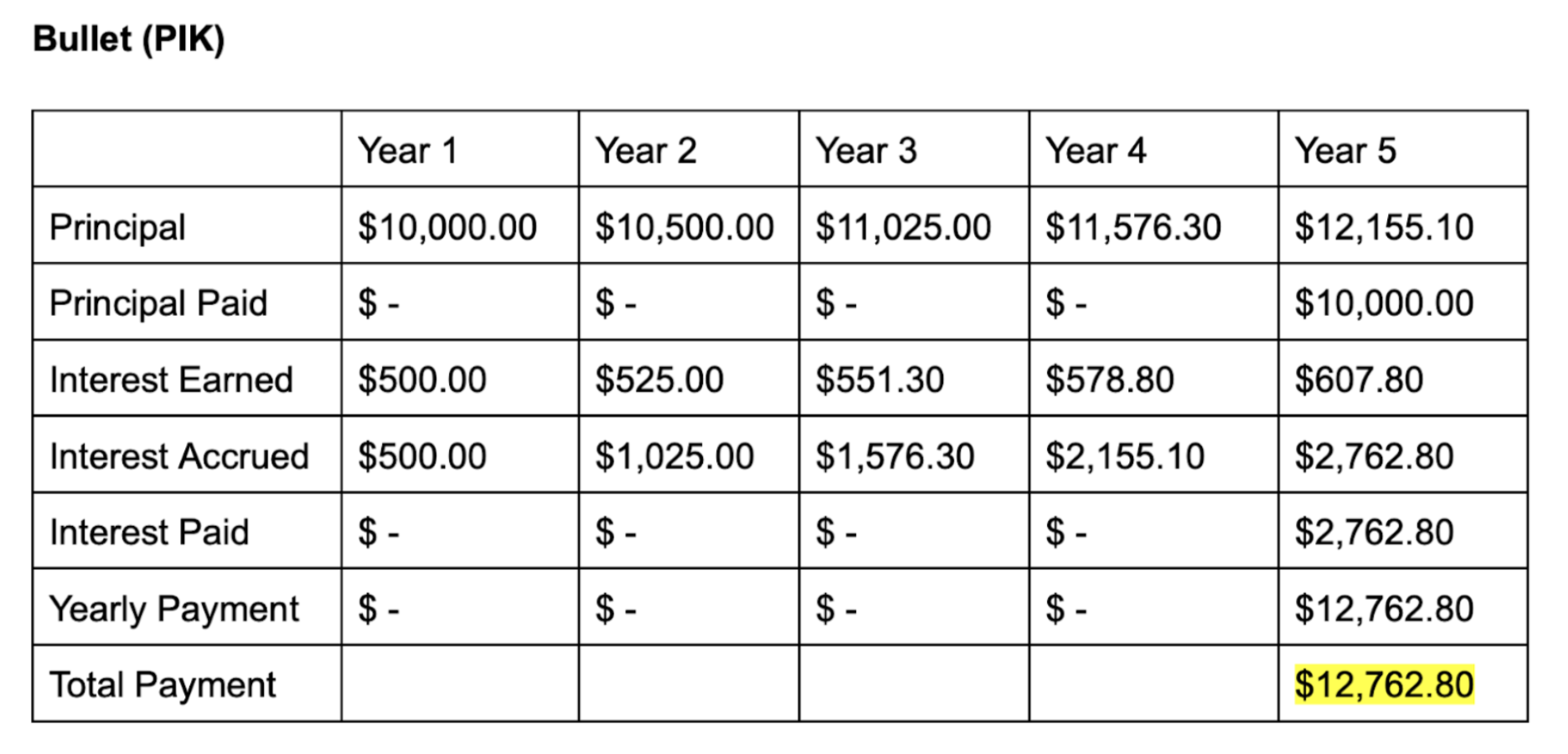
Bullet loans can have deferred interest payments or recurring interest payments. Deferred interest payments are often called Payment in Kind, (“PIK”) interest. PIK interest is deferred and added to the principal balance of the seller note. The interest is then compounding over time.

For example, if the principal balance of the seller note is $10,000 with an annual PIK interest of 5%, the first-year interest expense is $500.

The second year would be $525 because the prior year’s interest payment is added to the principal.

The third year interest would be $551.3 and so forth. Each year, the PIK interest is added to the principal amount and is due at the maturity date.

Bullet with PIK seller note example

Bullet (No PIK)

A bullet note can also include current interest payments rather than PIK interest payments. The original principal is still paid at maturity date, but the interest payments are made annually and do not compound. Using the same example above – a $10,000 seller note with 5% interest – the annual cash interest expense would be $500 each year. In the figure below, the interest is paid annually (or current) to the holder of the seller note.

Bullet without PIK seller note example

Amortization (Straight Line)

The most common method of repaying a bank loan is straight-line principal amortization over the term of the note with regular cash interest.

In simple terms, this means paying a portion of the principal and interest at every installment date. Each principal payment will be the same amount and the interest payment will decline over the life of the loan. Most bank loans with straight line amortization do not include deferred or PIK interest payments.

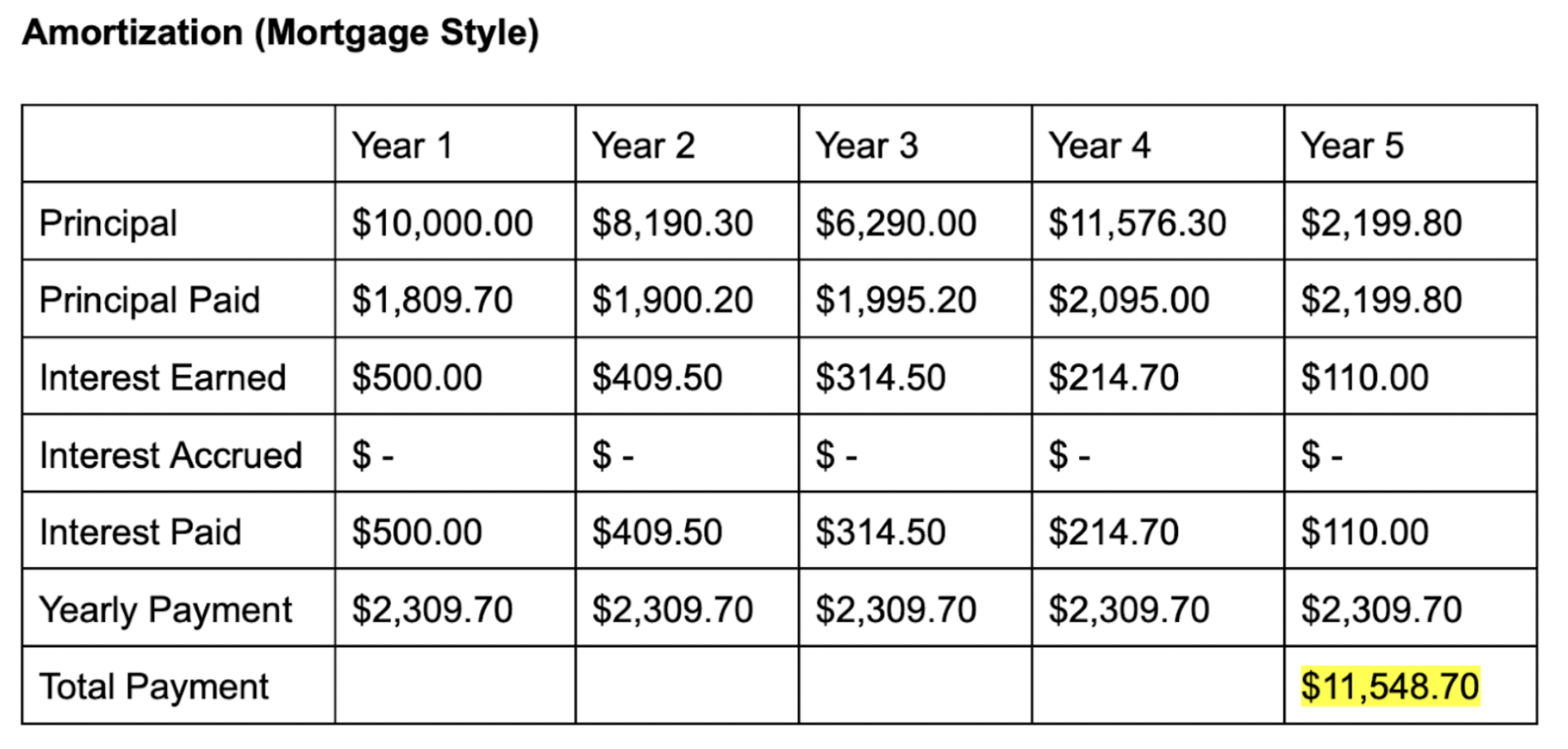
A straight line amortization note contrasts with a mortgage-style note. In a mortgage-style note, each payment amount is the same. While the interest portion decreases over the loan’s lifespan, the portion of principal paid increases.

Most commercial loans, including seller notes, rarely use this method of repayment.

Straight line amortization example

Mortgage style amortization example

Seller notes are most commonly structured as five-year bullet notes with current (no PIK) interest.

Benefits and Risks to the Seller

In small company transactions, the seller benefits from seller notes in many ways:

Benefits to the seller: 

  • Typically, a seller note allows for more flexibility in the acquisition and increases the probability of closing the transaction at a value acceptable to the seller.
  • Receiving interest over the life of the loan will increase the total value received, and the interest is often much higher than what the seller could have received from an upfront cash payment sitting in a bank account.
  • The seller knows the business well and can have confidence they will be repaid.

Where there are benefits to the seller, there are also risks.

Risks to the seller:

  • Most seller notes are unsecured. That means if the business were to fail, and the seller note defaults, there may not be any collateral to cover the seller note. The future performance of the business is unknown and, like for any lender, this presents a risk that the seller note may not be repaid.
  • Seller notes are subordinated to Senior Debt. If the business is not producing enough free cash to cover all of its obligations, then Senior Debt will be prioritized and the seller note may be impaired.

Conclusion

A seller note can be a great option to bridge a valuation or financing gap in a small company acquisition, to “fund” a buy/sell agreement, or to “fund” the sale of a business to a management team. Seller notes benefit both parties and can be structured to meet the unique requirements of the transaction.

However, it’s important to understand the structure as well as the benefits and risks of seller notes.

Do you have further questions about seller notes, or are you wondering how they might fit into the sale of your company? 1719 Partners is here to help— contact us today to get your questions answered.